Recycling Perovskite Solar Cells Could Solve a Lead Problem Before It Grows
Researchers report a recycling method that recovers lead and valuable metals from experimental perovskite solar cells, addressing one of the technology's most discussed environmental concerns.
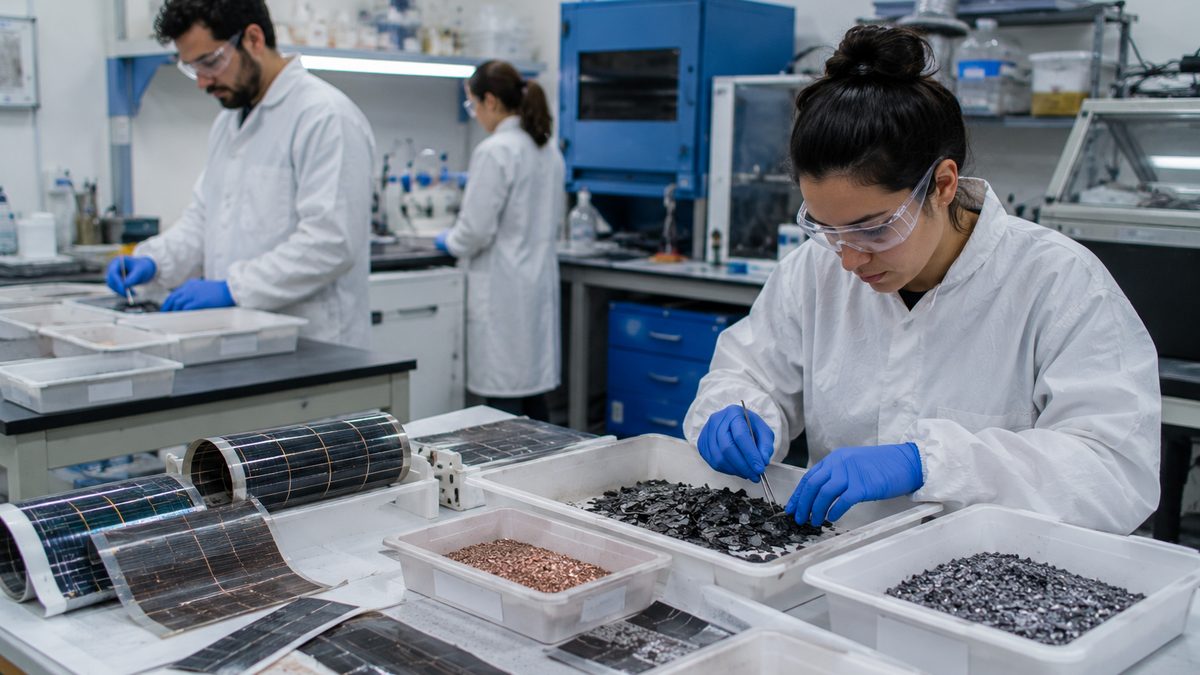
Researchers are studying ways to recover valuable materials from next-generation solar technologies before large-scale deployment. Editorial illustration by TheDailyGlobe.
Key Facts
- Researchers at Kanazawa University reported a one-step recycling method for flexible perovskite solar cells.
- The process is designed to recover lead along with valuable metals including gold and indium.
- Perovskite solar cells remain an emerging technology and are not yet widely deployed in commercial markets.
- Lead content has been one of the environmental concerns associated with some perovskite designs.
- The reported work focuses on recycling and material recovery rather than eliminating all environmental challenges associated with solar manufacturing.
Solar technology often comes with a simple promise: generate electricity from sunlight. But every energy technology eventually faces a less glamorous question. What happens when the equipment reaches the end of its useful life?
That question has become increasingly important for researchers developing perovskite solar cells, a newer type of solar technology that has attracted attention because of its potential efficiency and flexibility. While the technology shows promise, many perovskite designs contain lead, raising concerns about future waste management if the cells eventually reach large-scale use.
Why Perovskite Solar Cells Attract Attention
Traditional silicon solar panels dominate today's solar market, but researchers continue exploring alternatives that might offer different advantages. Perovskite solar cells have generated interest because they can be manufactured using different techniques and may eventually be used in lightweight or flexible applications that are difficult for conventional panels to match.
Scientists have spent years improving performance and durability, two areas that have historically limited broader adoption. At the same time, environmental questions have remained part of the discussion because many perovskite designs rely on lead-containing materials.
That concern does not mean perovskite technology is unsafe by definition. It does mean researchers have been looking for ways to address potential waste-management challenges before the technology reaches larger-scale deployment.
What the Researchers Developed
According to materials released by Kanazawa University and summarized by TechXplore, EurekAlert and Asia Research News, researchers developed a recycling approach designed to recover several valuable materials through a single process.
The reported method can recover lead while also extracting metals including gold and indium from flexible perovskite solar cells. Those materials have economic value, which could make recycling more practical than simply treating old devices as waste.
The idea is straightforward. If future solar products contain materials that require careful handling, recovering them before disposal could reduce waste while preserving resources that might otherwise need to be mined or processed again.
Why Recycling Matters Before Mass Deployment
One notable aspect of the research is its timing. The work focuses on a problem that could become important in the future rather than responding to a large existing waste stream.
Many technologies reach widespread adoption before recycling systems are fully developed. Researchers in this case are attempting to address end-of-life concerns early in the technology's development cycle.
For readers, the practical takeaway is not that millions of perovskite panels suddenly need recycling. Rather, scientists are trying to understand how potentially valuable and potentially hazardous materials could be recovered if the technology eventually becomes more common.
That approach reflects a broader trend in materials research: designing products with eventual recovery and reuse in mind instead of treating disposal as a separate problem to solve later.
What the Research Does Not Prove
The reported results are encouraging from a research perspective, but several important questions remain unanswered. Laboratory success does not automatically translate into large-scale industrial use.
Researchers will need to determine how the recycling method performs under commercial conditions, whether it remains economically practical at larger volumes and how efficiently materials can be recovered across different product designs.
The research also does not eliminate every environmental concern associated with manufacturing, transporting or eventually disposing of solar technologies. Recycling can reduce certain challenges, but it does not remove the need for broader evaluation of environmental impacts.
What Readers Should Watch Next
Future studies will likely focus on scaling the recycling process, improving recovery rates and evaluating costs. Researchers will also continue studying how perovskite solar cells perform over longer periods and whether they can meet durability requirements needed for wider commercial use.
For now, the work offers a glimpse into how scientists are thinking ahead about the full life cycle of emerging energy technologies. The research does not establish that perovskite solar cells will become a dominant part of the energy system. It does show that researchers are trying to solve potential waste and material-recovery challenges before they become much larger problems.
Reporting note: Reporting draws on research from Kanazawa University, materials published through EurekAlert and Asia Research News, TechXplore reporting, and reviewed background materials. This article was produced with AI-assisted research and reviewed by an editor before publication.