Pressure-Activated Adhesive Could Make Manufacturing Simpler and Safer
Researchers are testing a pressure-activated adhesive that keeps two reactive components separate until they are pressed together, a design that could simplify some manufacturing processes if it proves practical at scale.
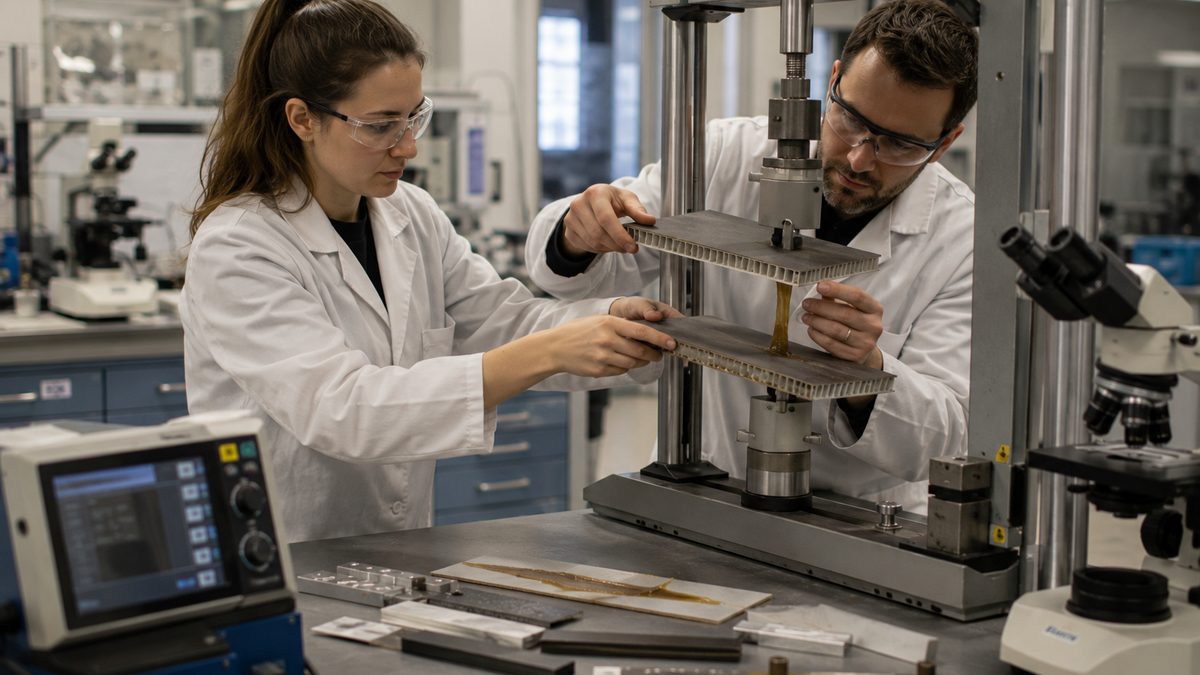
Researchers are studying pressure-activated adhesives that could simplify some manufacturing processes while reducing direct handling of reactive materials. Editorial illustration by TheDailyGlobe.
Key Facts
- Fraunhofer IAP researchers developed a pressure-activated two-component adhesive using microscopic capsules.
- The adhesive components remain separated until pressure breaks the capsules.
- The approach is designed to activate at room temperature during pressing rather than requiring heat.
- Researchers say the technology could reduce direct handling of reactive adhesive components during manufacturing.
- The system remains under development and has not yet been adopted for widespread industrial production.
Whether assembling a car, building furniture, manufacturing electronics, or producing lightweight equipment, adhesives often require careful preparation before they can be used. Many industrial glues depend on precisely mixing two reactive ingredients, controlling curing times, and sometimes adding heat before a strong bond is formed. Those extra steps can make production slower and require workers to handle reactive chemicals directly.
Researchers at Germany's Fraunhofer Institute for Applied Polymer Research (IAP) are exploring a different approach. Instead of mixing two adhesive components immediately before use, they developed a system that keeps those ingredients separated inside microscopic capsules. The adhesive activates only when pressure breaks the capsules during assembly, allowing the components to mix at the moment they are needed.
Why Two-Component Adhesives Can Be Challenging
Many industrial adhesives consist of two separate chemicals that begin reacting once they are mixed together. Manufacturers typically measure the ingredients carefully, combine them shortly before use, and work within a limited period before the adhesive hardens. Depending on the product, curing may also require elevated temperatures or specialized equipment.
Those steps help produce reliable bonds, but they also add complexity to manufacturing. Precise mixing equipment, timing, and handling procedures can become important parts of the production process, particularly in industries that manufacture large numbers of identical products.
How Pressure Activates the Adhesive
The new system approaches the problem differently. One reactive component is enclosed inside tiny capsules while the other remains outside them. During storage and handling, the two ingredients stay separated, preventing the chemical reaction from starting prematurely.
When pressure is applied during assembly, the microscopic capsules rupture. That allows the ingredients to combine and begin the bonding process without requiring workers to mix the chemicals manually at the point of use. According to Fraunhofer IAP, the process is designed to occur at room temperature during pressing.
Where the Technology Could Be Useful
If further development proves successful, pressure-activated adhesives could become useful in manufacturing environments where consistent assembly, simplified production steps, or reduced handling of reactive materials are important. Industries that assemble lightweight panels, composite materials, consumer products, or other manufactured components could potentially benefit from a system that activates only when pressure is applied.
The research does not suggest that existing adhesives will be replaced broadly. Different manufacturing applications require different bonding properties, environmental resistance, curing characteristics, and production speeds. Many current adhesive systems are already well suited to the products they help manufacture.
Questions Still Need Answers
The technology remains in the research stage, and several practical questions must be answered before manufacturers could consider widespread adoption. Researchers will need to demonstrate that the capsules remain stable during storage, rupture consistently during production, and produce durable bonds under real-world operating conditions.
Cost, manufacturing speed, long-term reliability, and compatibility with existing production equipment will also influence whether companies eventually adopt the technology. The available research does not establish when—or whether—the adhesive will move into large-scale commercial manufacturing.
What Comes Next
Future research is likely to focus on refining the capsule design, improving manufacturing performance, and testing the adhesive across a wider range of industrial applications. Additional engineering studies will determine how the system performs outside laboratory conditions and whether it can meet the demands of high-volume production.
For now, the work demonstrates another example of how materials science continues to simplify familiar manufacturing processes. While pressure-activated adhesives are not ready to replace today's industrial bonding methods, the concept shows how changing when an adhesive becomes active could eventually make some assembly processes easier to manage while reducing the need to mix reactive components immediately before use.
Reporting note: Reporting draws on research and technical materials from the Fraunhofer Institute for Applied Polymer Research (IAP) and reviewed background information. This article was produced with AI-assisted research and reviewed by an editor before publication.