New Lidar Could Help Robots See More Than Distance
Researchers have developed a lidar system that can measure distance, motion and surface characteristics at the same time, potentially giving robots a richer view of their surroundings.
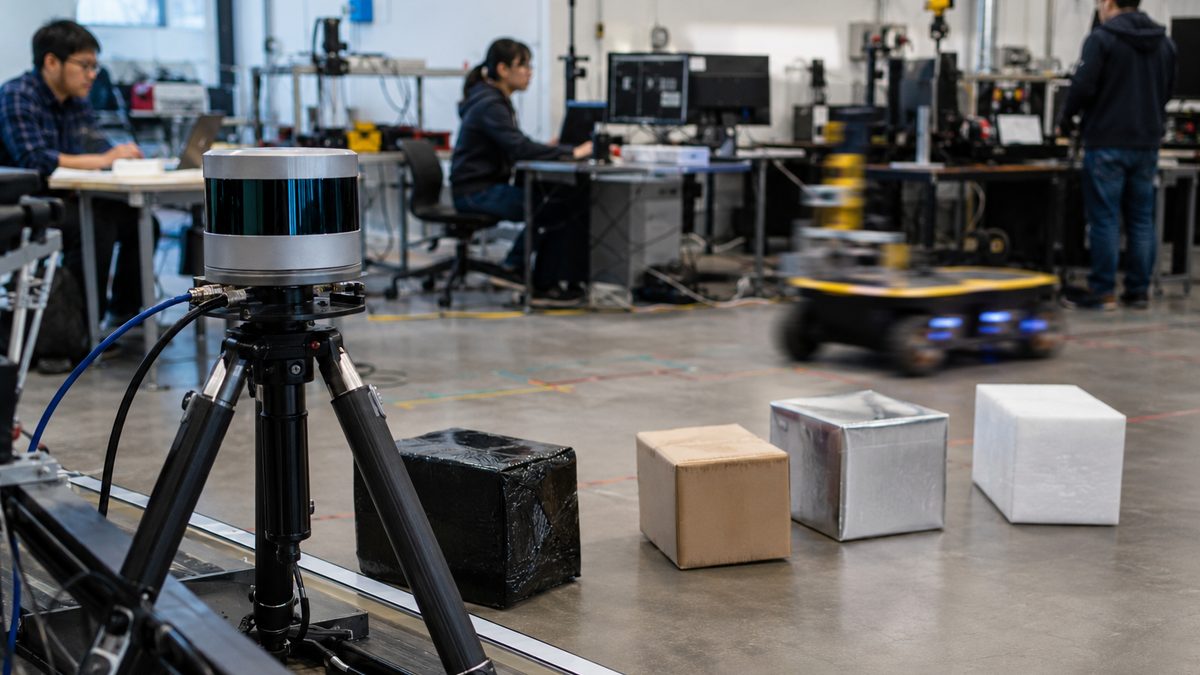
Researchers are exploring lidar systems that can gather more information about objects than distance alone. Editorial illustration by TheDailyGlobe.
Key Facts
- Researchers reported a lidar system that measures distance, speed and material-related information simultaneously.
- The work was described in research published through Optica in June 2026.
- Traditional lidar systems are primarily used to determine the location and distance of objects.
- The researchers say the new approach could provide additional environmental information for robotic systems.
- The technology remains a research development and is not yet broadly deployed in commercial autonomous systems.
For a robot, seeing the world is not as simple as taking a picture. A machine moving through a warehouse, factory or roadway needs to know where objects are, whether they are moving, and how close they might be. In some situations, it would also be useful to know something about the surface of those objects before making a decision.
Researchers recently reported a new lidar system designed to gather several types of information at once. Instead of measuring only distance, the system can also capture information related to an object's speed and certain material characteristics in a single measurement process.
How Lidar Normally Works
Lidar, short for light detection and ranging, works by sending pulses of laser light toward an object and measuring how long it takes for the reflected light to return. That information can be used to build a three-dimensional picture of a surrounding environment.
The technology is already used in a variety of applications, including mapping, industrial measurement, robotics research and some vehicle-sensing systems. Its primary strength is helping machines understand where things are located in space.
However, distance alone does not always provide a complete picture. Two objects may be the same distance away but have very different properties. A robot navigating a complex environment may benefit from additional information when interpreting what it sees.
What This New System Adds
According to the research highlighted by Optica, TechXplore and EurekAlert, the new lidar approach combines several sensing functions into a single measurement. In addition to identifying location, it can gather information related to motion and certain surface characteristics.
Motion information can help determine whether an object is stationary or moving and how quickly it is moving. Material-related information may provide clues about the nature of the surface being observed. Researchers believe combining these capabilities could help machines build a richer understanding of their environment.
Instead of relying on multiple separate sensing systems to collect different types of information, future designs might be able to gather more data through a single sensing process. The research focuses on demonstrating that capability rather than proving a specific commercial application.
Why Surface Information Could Matter
Humans often identify objects using more than shape and distance. We recognize differences between metal, glass, fabric and other materials through visual cues and experience. Machines typically require dedicated sensors or software analysis to make similar distinctions.
The ability to gather material-related information directly through lidar could potentially help robotic systems interpret their surroundings more effectively. In industrial settings, that information might assist with sorting, inspection or navigation tasks. In research environments, it could provide additional data for machine perception systems.
The researchers have not claimed that the technology automatically identifies every material or solves broader challenges in machine perception. Rather, the work demonstrates a new way to collect additional information during the sensing process.
What Remains Before Real-World Deployment
As with many laboratory advances, there is a difference between demonstrating a concept and deploying it at scale. The available reports describe a research achievement, not a finished commercial product.
Several questions remain unanswered. Researchers will need to evaluate how the system performs under different environmental conditions, how reliably it works outside controlled settings and how easily it can be integrated into existing robotic platforms.
Cost, durability, processing requirements and long-term reliability are also important considerations. Many promising sensing technologies require years of additional testing and engineering before they become common in commercial products.
What Readers Should Watch Next
Future research will likely focus on refining the system, testing it in more complex environments and determining where its additional sensing capabilities provide the greatest practical benefit. Engineers and robotics researchers will also be interested in how the technology compares with existing sensing approaches.
For now, the development is best viewed as an example of how machine perception continues to evolve. The advance does not mean robots suddenly understand the world the way humans do. It does suggest that researchers are finding new ways to help machines gather more information about the environments around them, potentially expanding what future robotic systems can perceive and interpret.
Reporting note: Reporting draws on Optica research, TechXplore coverage, EurekAlert materials, and reviewed background reporting. This article was produced with AI-assisted research and reviewed by an editor before publication.