A Nanoscale Superconductor Design Points Toward More Efficient Electronics
Researchers report that changing the surface beneath an ultrathin superconductor can improve its performance, offering a potential path toward more energy-efficient electronic technologies.
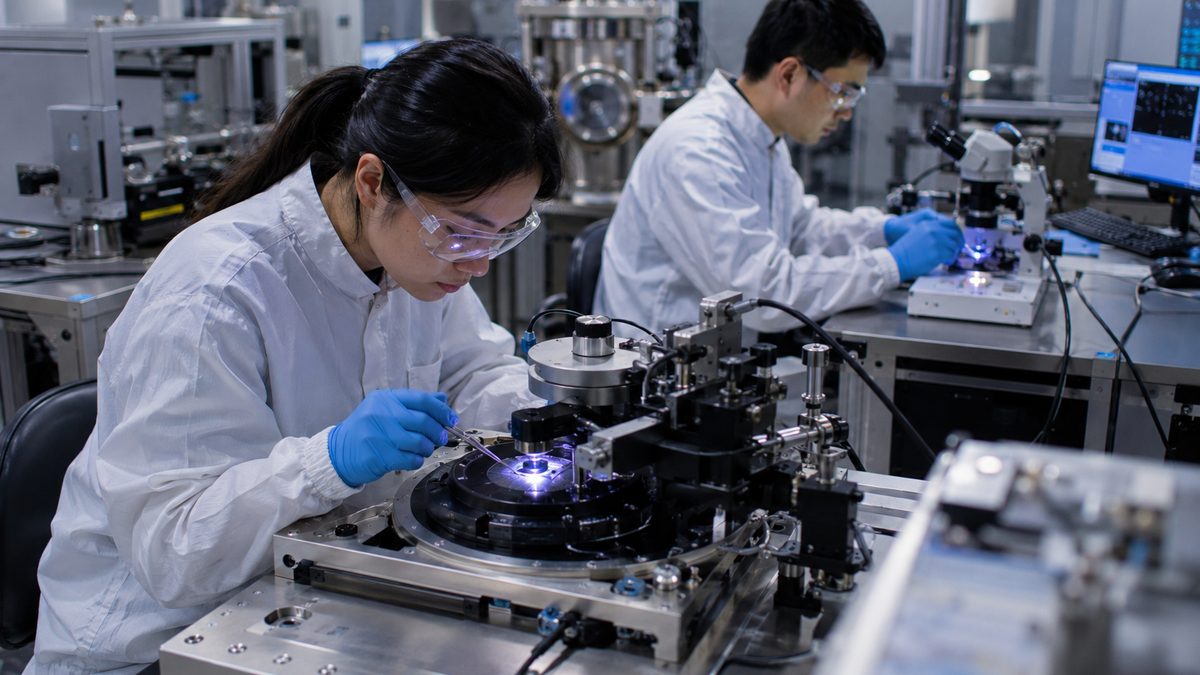
Researchers are exploring ways to improve superconducting materials by changing the structures beneath them rather than altering their chemistry. Editorial illustration by TheDailyGlobe.
Key Facts
- Researchers at Chalmers University of Technology reported improved performance in an ultrathin superconducting material through nanoscale substrate design.
- The work focused on modifying the surface beneath the superconductor rather than changing the material's chemical composition.
- The researchers reported improvements related to operation at higher temperatures and under stronger magnetic fields.
- Superconductors can carry electricity without resistance under specific conditions.
- The research remains at the laboratory stage and is not yet part of commercial electronics.
Every electronic device generates heat. Whether it is a smartphone, a laptop, a data center or an advanced artificial intelligence system, some energy is lost as electricity moves through materials. Engineers have spent decades looking for ways to reduce those losses because wasted energy means higher costs, more cooling requirements and lower efficiency.
One long-standing area of research involves superconductors, materials that can carry electricity without electrical resistance under certain conditions. Researchers at Chalmers University of Technology recently reported a new approach that improved the performance of an ultrathin superconducting material not by changing the material itself, but by redesigning the surface underneath it.
Why Heat Matters in Modern Electronics
Most people notice heat when a laptop fan starts spinning loudly or when a phone becomes warm during heavy use. Behind the scenes, however, heat is one of the central challenges in electronics design. As devices become more powerful, managing energy losses becomes increasingly important.
Data centers, high-performance computing systems and advanced research equipment all consume significant amounts of electricity. Even small improvements in efficiency can matter when applied across thousands or millions of devices.
That is one reason scientists remain interested in superconductors. If electricity can move without resistance, energy losses can be dramatically reduced. The challenge is that superconductors typically require specific temperatures and conditions that limit practical deployment.
What the Researchers Changed
Instead of trying to improve superconducting performance through chemistry alone, the Chalmers research team focused on the nanoscale structure beneath an ultrathin superconducting film. According to reports from Chalmers, ScienceDaily and Phys.org, the researchers redesigned the substrate, the supporting surface on which the superconducting material sits.
At extremely small scales, surfaces can influence how materials behave. By engineering that underlying structure, the team reported improvements in superconducting performance without fundamentally changing the superconductor's composition.
For readers unfamiliar with nanotechnology, the concept can be compared to changing the foundation beneath a building rather than rebuilding the structure itself. The building remains largely the same, but the support system alters how it performs.
Why Temperature and Magnetic Fields Matter
One of the major limitations of superconductors is that their special properties disappear when conditions move beyond certain thresholds. Temperature is one factor. Magnetic fields are another.
Researchers reported that the redesigned substrate helped the ultrathin material maintain superconducting behavior under higher temperatures and stronger magnetic fields than would otherwise be possible. While the reported temperatures remain far below ordinary room temperatures, any improvement can be valuable for researchers attempting to expand the practical range of superconducting technologies.
Magnetic-field performance is also important because many potential applications involve environments where magnetic fields are unavoidable. Medical imaging systems, scientific instruments and advanced computing technologies often operate under conditions that place demands on superconducting materials.
What This Could Mean for Future Computing
The research may eventually prove useful for future generations of electronic systems that require extremely efficient electrical performance. Areas frequently discussed by researchers include advanced computing, sensing technologies and specialized scientific equipment.
However, the current findings should be viewed as an early materials-science result rather than a roadmap to near-term consumer products. The research demonstrates a new design approach, not a finished technology ready for mass production.
Many scientific advances require years of additional testing, engineering and manufacturing development before they can be incorporated into commercial systems.
What Remains Unclear
Several important questions remain unanswered. It is not yet clear how easily the substrate-design approach can be scaled for larger manufacturing processes or how it will perform across different superconducting materials.
The research also does not represent room-temperature superconductivity, a goal that continues to attract scientific interest but remains outside the scope of this work. Available reporting does not suggest that everyday consumer electronics will adopt this technology in the near future.
What Readers Should Watch Next
Future studies will likely explore whether similar nanoscale design techniques can improve other superconducting materials and whether the approach can be integrated into larger systems. Researchers will also continue evaluating how these materials behave under increasingly demanding conditions.
For now, the work highlights an interesting shift in thinking. Rather than focusing only on changing a material's chemistry, scientists are showing that the structures surrounding a material can sometimes be just as important. That insight could help guide future efforts to build electronics that waste less energy and perform more efficiently, even if practical applications remain years away.
Reporting note: Reporting draws on research from Chalmers University of Technology, ScienceDaily coverage, Phys.org reporting, and reviewed background materials. This article was produced with AI-assisted research and reviewed by an editor before publication.