A Light-Based Chip Shows How Future Computing May Move Beyond Wires
Researchers developed a nanoscale chip that can generate, steer, and read information carried by light, offering a glimpse of how future computing hardware could evolve beyond traditional electrical pathways.
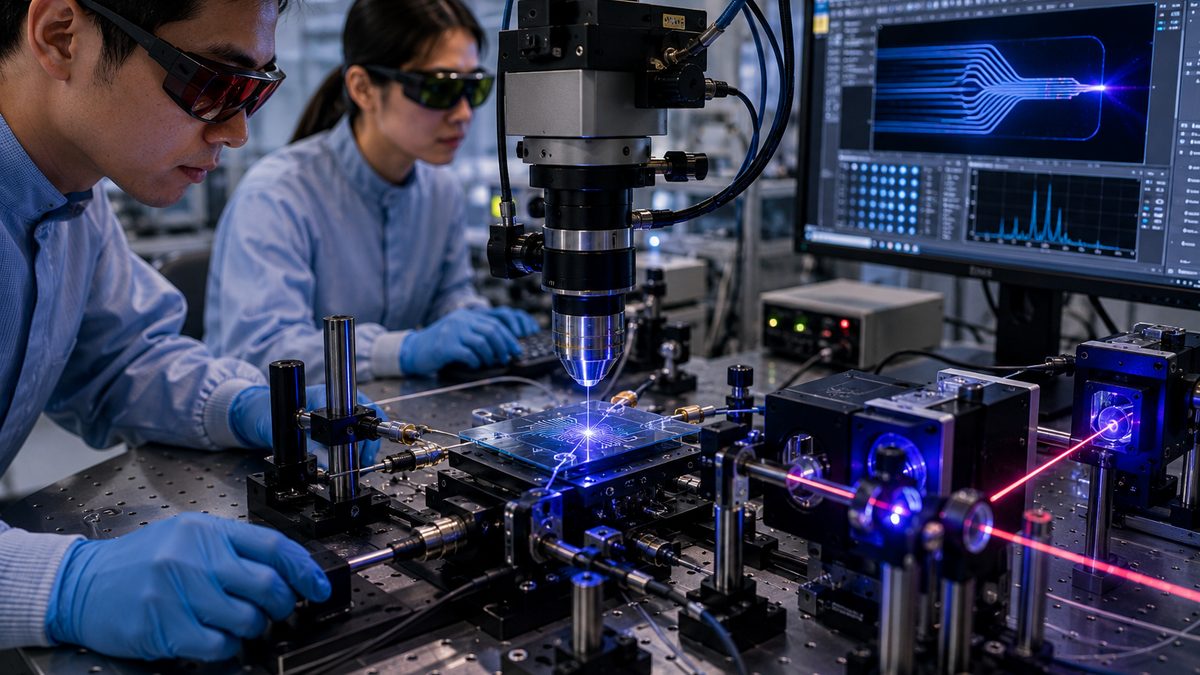
Photonic chip research is exploring ways to move information with light instead of only electrical signals. Editorial illustration by TheDailyGlobe.
Key Facts
- Monash University researchers developed a nanoscale photonic circuit.
- The device can generate, direct, and read light-based information on a single chip.
- The research uses atomically thin materials and nanoscale structures.
- Researchers describe potential future relevance to AI and quantum technologies.
- The device remains a research project rather than a commercial computing product.
For decades, faster computing has often meant shrinking components and squeezing more performance out of electronic circuits. But as chips become increasingly complex, engineers face a stubborn challenge: moving information around a device creates heat, consumes energy, and eventually runs into physical limits.
That challenge has prompted researchers to explore alternatives to traditional electrical signals. One idea receiving growing attention is photonic computing, which uses light instead of electricity for some information-processing tasks.
Researchers at Monash University recently reported a nanoscale photonic circuit that can generate, direct, and read light-based information on a single chip. The work remains firmly in the research stage, but it offers a look at how future computing hardware might handle information differently than today's processors.
Why Engineers Are Looking Beyond Electrical Signals
Modern computers move enormous amounts of information every second. That movement relies largely on electrical signals traveling through increasingly tiny pathways built into chips.
Electrical systems have powered computing for generations, but they come with tradeoffs. Signals can generate heat, consume power, and face bottlenecks as designers try to move more information through smaller spaces. Researchers around the world are investigating whether light can help address some of those limitations.
Light can carry information at extremely high speeds. The challenge has been building practical devices that can control, direct, and interpret that information on chips small enough to fit into future computing systems.
What the Monash Team Built
According to Monash University and related science reporting, the new device combines several capabilities that researchers often study separately. The chip can create light-based signals, guide them through nanoscale structures, and read the resulting information within a single integrated system.
The research involves photonics and a field known as valleytronics. While the technical details are complex, the basic goal is easier to understand: finding new ways to encode and move information through materials at extremely small scales.
Researchers reported using atomically thin materials and carefully engineered nanoscale structures to make the system work. These materials can interact with light in ways that conventional electronic components cannot, opening possibilities for new forms of information processing.
Why AI and Quantum Researchers Are Paying Attention
The project has drawn interest because future AI systems and quantum technologies may require enormous computing resources. Researchers frequently search for hardware approaches that can process information more efficiently or move data more effectively.
That does not mean the Monash device is an AI chip or a quantum computer. It is neither. Instead, researchers describe it as a building block that could potentially contribute to future generations of computing hardware if additional development proves successful.
The distinction matters. Many research projects show promise in laboratory settings but never become commercial products. The current findings demonstrate that the underlying concept can work under research conditions, not that it is ready for deployment in data centers, personal devices, or commercial AI systems.
The Road From Lab Device to Useful Hardware
Several major questions remain unresolved. One of the biggest is manufacturing. Researchers have shown that the concept can be built, but available reporting does not establish whether it can be produced economically at large scale.
Integration presents another challenge. Modern semiconductor manufacturing relies on highly developed production systems that have been refined over decades. Any new technology must either fit into those systems or provide enough benefits to justify entirely new manufacturing approaches.
Performance comparisons also remain limited. It is not yet clear how this approach stacks up against other photonic technologies, advanced electronic systems, or competing research efforts pursuing similar goals.
What Readers Should Watch Next
The next milestones will likely involve larger and more capable prototypes. Researchers will need to demonstrate that similar concepts can operate reliably in more complex circuits while maintaining the characteristics that make photonic computing attractive.
Independent testing, manufacturing studies, and integration with existing chip platforms will also be important. Those developments could provide a clearer picture of whether this technology belongs primarily in research laboratories or has a realistic path toward practical computing systems.
For now, the Monash project serves as a reminder that the future of computing depends on more than software. Behind every AI model, cloud service, and advanced application is physical hardware that must move information efficiently. Researchers believe light may eventually play a larger role in that process, but important engineering challenges remain before that possibility becomes everyday reality.
Reporting note: Reporting draws on university research materials, science reporting, photonics technology reporting, and reviewed background materials. This article was produced with AI-assisted research and reviewed by an editor before publication.