Could Refineries One Day Use Less Heat? Researchers Test a New Membrane Approach
Researchers from KAIST and Georgia Tech have developed a polymer membrane that separates components of crude oil at room temperature, an early-stage technology that could reduce energy use if it proves practical at industrial scale.
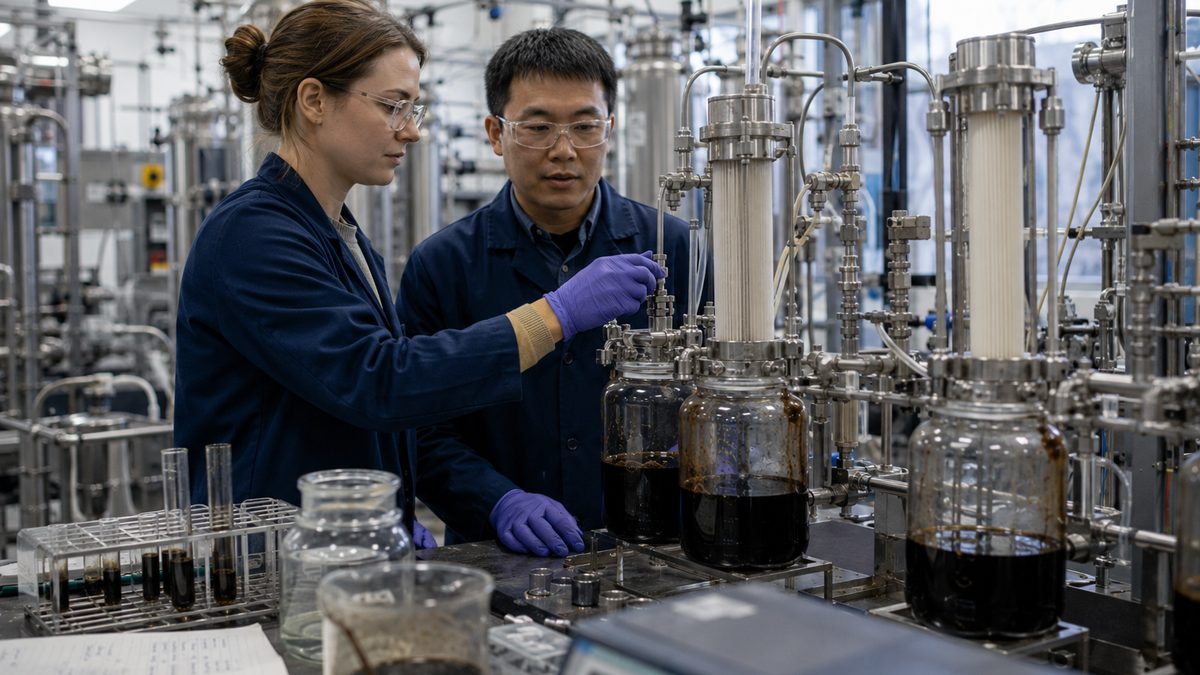
Researchers are studying whether membrane technology could one day reduce the amount of heat required during parts of the oil refining process. Editorial illustration by TheDailyGlobe.
Key Facts
- Researchers from KAIST and Georgia Tech developed a polymer membrane that separates crude oil at room temperature.
- The research was published in the peer-reviewed journal Nature.
- Today's refineries primarily separate crude oil using heat-intensive distillation.
- Researchers say the technology remains in the research stage and has not yet been proven for large-scale commercial refinery operations.
Almost everything made from petroleum—from gasoline and jet fuel to plastics and household products—begins with a process that relies heavily on heat. Refineries spend enormous amounts of energy heating crude oil so its different components can be separated by their boiling points. Researchers now say they have demonstrated another way to perform part of that job without first bringing crude oil to extremely high temperatures.
Scientists from the Korea Advanced Institute of Science and Technology (KAIST) and the Georgia Institute of Technology have developed a polymer membrane capable of separating crude oil at room temperature. The work, published in the journal Nature, represents a laboratory-scale advance that researchers believe could eventually reduce the energy required for some refining operations if the technology can be successfully expanded.
Why Refineries Depend on Heat
Crude oil is not a single substance but a complex mixture of hydrocarbons with different chemical properties. Modern refineries typically separate those compounds using distillation, a process that heats crude oil until different components vaporize at different temperatures. As the vapor cools inside a distillation column, products such as gasoline, diesel fuel, jet fuel, and heavier oils can be collected at different levels.
Distillation has been refined over many decades and remains one of the industry's most reliable methods. It is also energy intensive because maintaining extremely high temperatures requires significant fuel and infrastructure.
How the Membrane Works
Instead of relying on boiling points, the experimental membrane separates molecules as crude oil passes through specially designed polymer materials. The membrane selectively allows certain hydrocarbons to move through while slowing or blocking others, creating separation without requiring the entire mixture to be heated first.
Although membrane technologies are already used in applications such as water treatment and gas separation, crude oil presents a far more difficult challenge because it contains thousands of different compounds with widely varying sizes and chemical characteristics. According to the researchers, developing a membrane capable of handling that complexity represented a significant scientific hurdle.
Why Energy Savings Matter
Heating crude oil accounts for a substantial share of the energy consumed during refining. If membrane-based systems eventually prove capable of replacing or reducing portions of conventional distillation, refineries could potentially lower energy demand for some processing steps. Reduced energy use could also lower operating costs and improve overall efficiency.
Researchers caution, however, that the study does not demonstrate an immediate replacement for existing refinery equipment. Commercial refineries process enormous volumes of crude oil continuously under demanding industrial conditions. Laboratory success does not automatically translate into practical large-scale operation.
Questions Still Need Answers
Several important questions remain before the technology could move beyond the laboratory. Researchers will need to determine how durable the membranes are during long-term operation, how quickly they can process industrial volumes of crude oil, how resistant they are to fouling and contamination, and whether manufacturing costs would make widespread adoption practical.
It is also unclear whether membrane systems would replace existing distillation equipment or work alongside it by performing only certain stages of the refining process. The published research does not establish how future refinery designs might incorporate the technology.
What Comes Next
The publication in Nature marks an important milestone for the research, but additional engineering and commercial testing would be needed before refineries could consider large-scale deployment. Pilot-scale demonstrations, durability studies, and economic evaluations are likely to play an important role in determining whether the concept can move beyond laboratory success.
For now, the study offers a glimpse of how one of the world's oldest industrial processes might eventually become more efficient. The idea of separating crude oil without first heating it to extreme temperatures remains experimental, but it highlights how advances in materials science continue to explore new ways of improving technologies that underpin much of the modern economy.
Reporting note: Reporting draws on peer-reviewed research published in Nature, materials from KAIST and the Georgia Institute of Technology, and reviewed background information. This article was produced with AI-assisted research and reviewed by an editor before publication.