A New Carbon Capture Method Uses Electricity Instead of Heat
MIT researchers are studying an electrochemical approach that could make carbon capture more flexible, but the method still has to prove durability, scale and cost.
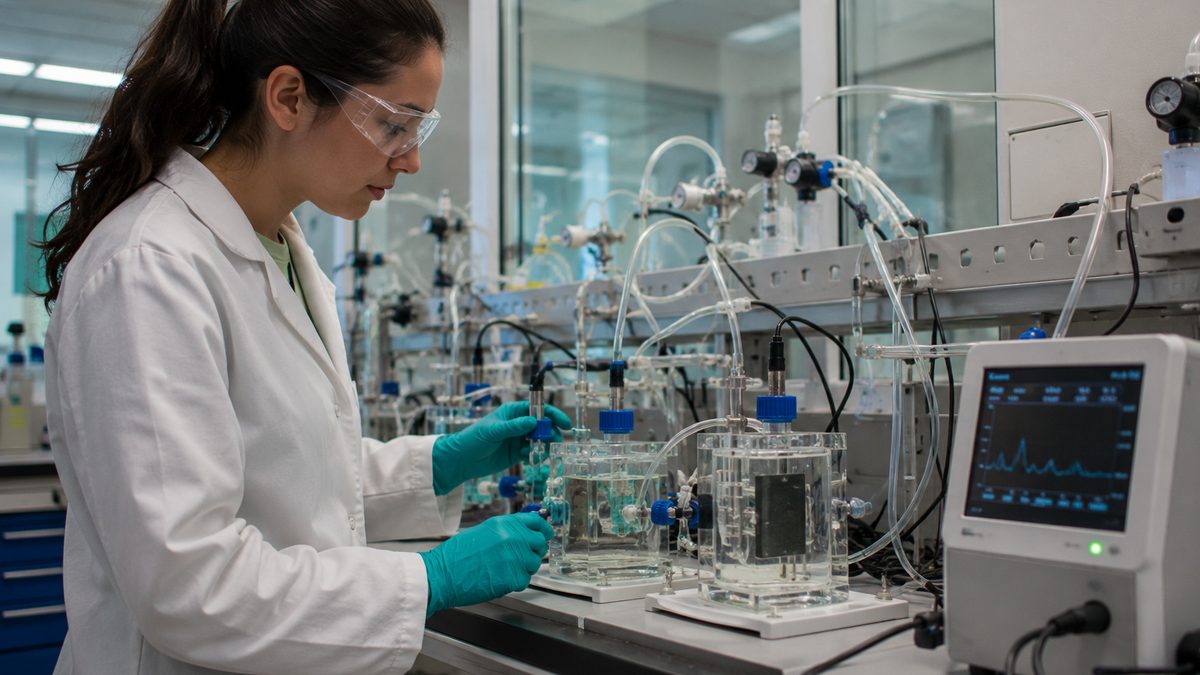
Researchers are exploring carbon capture methods that use electricity to bind and release carbon dioxide. Editorial illustration by TheDailyGlobe.
Key Facts
- MIT researchers are exploring electrochemically mediated carbon capture.
- The work uses N-heterocyclic imines, including a bis(NHI) structure.
- The goal is to make CO2 capture more energy-efficient and flexible than some conventional approaches.
- The method still has to prove stability, cycling durability and scale-up before practical deployment.
- The research should not be read as a finished solution to industrial carbon capture.
Capturing carbon dioxide sounds simple until the energy bill enters the picture.
Many carbon capture systems work by using chemical materials that grab CO2 from a gas stream, then release it later so it can be stored or used. The release step often takes heat. That can make the process energy-intensive, especially for industries already trying to cut emissions without adding another large energy demand.
MIT researchers are exploring a different route: using electricity to help control when carbon dioxide is captured and released. The research is still far from proving commercial readiness, but it gives readers a clearer way to understand where carbon capture technology may be headed.
Why Heat Is a Problem
Conventional carbon capture often relies on materials that bind with carbon dioxide and then release it when conditions change. In many systems, heat helps drive that release.
That heat requirement matters. If a factory, power plant or industrial site has to use large amounts of energy to capture carbon, the climate benefit and operating cost both become harder questions. The technology may still reduce emissions, but it is not free. It needs equipment, energy, maintenance and a place for the captured CO2 to go.
That is why researchers keep looking for ways to capture carbon with less energy or with energy that can be controlled more precisely. Electricity is appealing because it can be turned on and off, adjusted and potentially paired with cleaner power sources. But an electric approach still has to work reliably in real systems, not only in a lab setup.
What Electrochemical Capture Means
Electrochemical carbon capture uses electricity to change how molecules behave. In plain language, the electric input helps tune a material so it can bind CO2 under one condition and release it under another.
The MIT work focuses on N-heterocyclic imines, including a bis(NHI) structure. Those molecules are being studied because they can interact with carbon dioxide in ways that may be controlled by electrochemical changes.
The idea is not that electricity magically makes carbon disappear. The carbon dioxide still has to be captured, separated, moved and eventually stored or used. The potential advantage is in how the capture-and-release cycle is managed.
If the chemistry can be made stable and efficient, an electrochemical system could offer more flexibility than processes that depend heavily on heating and cooling. That flexibility could matter for industrial sites with changing operations, variable energy prices or access to cleaner electricity at certain times.
Why the Molecules Matter
In carbon capture, the details of the capturing material are central. A good material has to grab CO2 strongly enough to separate it from other gases, but not so strongly that releasing it becomes too difficult or expensive.
That balance is one of the hard parts. If the material is too weak, it does not capture enough carbon dioxide. If it is too strong, the system may require too much energy to reset. If it breaks down over repeated use, the economics and reliability suffer.
The NHI approach is interesting because it aims to use molecular behavior that can be controlled with electricity. In theory, that could allow researchers to design a system where CO2 capture and release are more tunable.
But tunable should not be mistaken for ready. Lab chemistry can show promise while still facing major barriers in real industrial conditions. Gases can contain impurities. Systems must run many cycles. Materials must last. Equipment has to be built, maintained and paid for.
What Still Has to Be Proven
The central questions are practical. Can the materials remain stable over many capture-and-release cycles? Can the system handle realistic gas streams? Can it operate at useful scale? Can it compete on cost and energy use with existing carbon capture methods?
Durability is especially important. A carbon capture system that works well for a short test may still fail if the active material degrades too quickly. Cycling durability determines whether the same material can be used again and again without losing performance.
Scale is another challenge. Industrial carbon capture is not a tabletop problem. Factories, power plants, cement operations and other heavy-emitting sites can produce large volumes of CO2-containing gas. A system has to move and process that gas safely and efficiently.
Cost may be the deciding factor. Even if an electrochemical method uses less heat, it still needs equipment, electricity, materials and operations. It also needs a full plan for what happens after CO2 is captured.
Why This Research Still Matters
The value of the MIT work is that it points to a different design path for carbon capture. Instead of treating capture mainly as a heat-driven chemical process, researchers are testing whether electricity can give them finer control over the chemistry.
That could matter if carbon capture becomes part of the toolkit for industries that are difficult to decarbonize. Some sectors cannot simply switch off emissions overnight. Cleaner power, efficiency, process changes and alternative materials may reduce emissions, but capture technology may still be considered for some remaining sources.
The cautious way to read the research is this: it is a possible improvement in one part of a larger system, not a complete answer to climate pollution. Carbon capture still faces questions about cost, energy, infrastructure, storage and public policy.
The practical takeaway is that carbon capture is not one technology. It is a field of competing methods, each trying to solve the same hard problem: separating carbon dioxide without using so much energy that the solution creates new problems. Using electricity instead of heat may help in some future systems, but only if the chemistry can survive the long, expensive path from promising lab work to dependable industrial use.
Reporting note: Reporting draws on MIT research materials, MIT Climate background, technology reporting, carbon capture industry coverage, and reviewed background materials. This article was produced with AI-assisted research and reviewed by an editor before publication.