AI Lab Assistants Could Help Scientists Program Robots Faster
PNNL's AutoLabs system points to a practical use for AI in research labs: helping scientists turn experiment goals into instructions autonomous lab robots can follow.
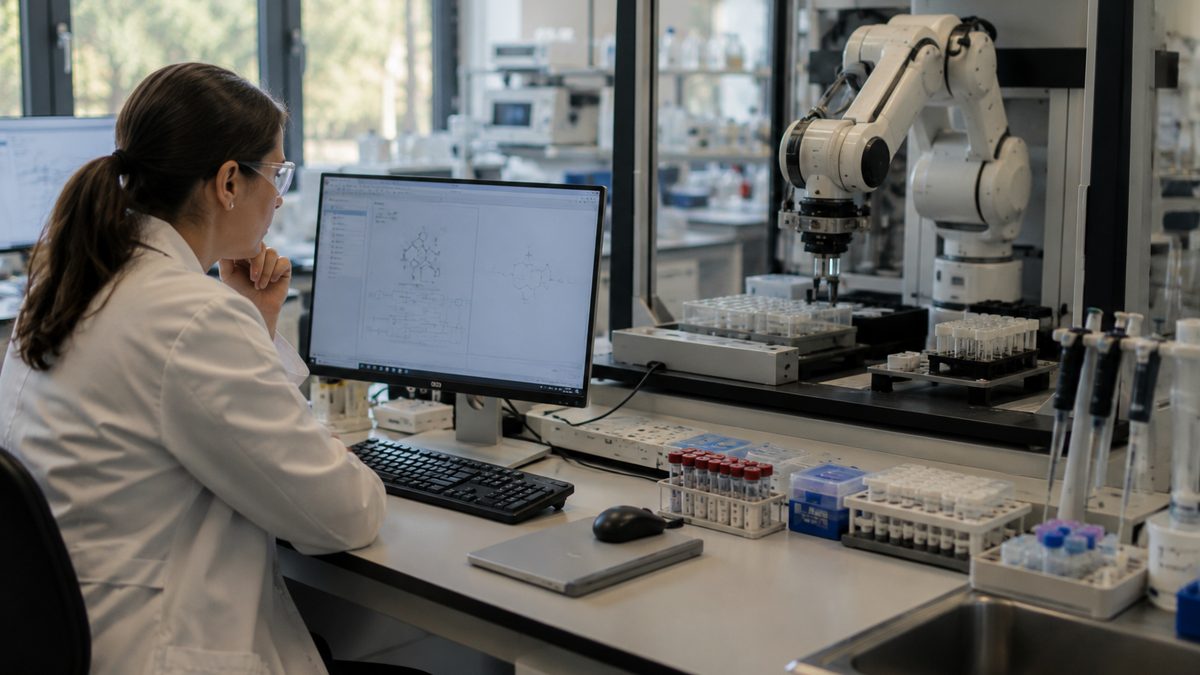
AI systems may help researchers translate experiment goals into instructions for lab robots, but scientists remain central to the work. Editorial illustration by TheDailyGlobe.
Key Facts
- Pacific Northwest National Laboratory developed AutoLabs, an agentic AI system for autonomous lab work.
- The system is designed to translate scientists' experiment goals into robot-specific instructions.
- The research addresses a real bottleneck: lab robots can run experiments, but programming them can take weeks.
- Natural-language experiment planning could make it easier for scientists to communicate with automated lab systems.
- The work does not mean AI can replace scientists or that fully autonomous discovery is already routine.
Modern research labs can have sophisticated robots, automated instruments and machines capable of running carefully controlled experiments. But before a robot can do useful work, someone still has to tell it exactly what to do.
That setup step can be slower than the technology makes it sound. A scientist may know the experiment they want to run, while an engineer or automation specialist has to translate that goal into instructions the lab robot can understand. The back-and-forth can take time, especially when the robot, software and scientific plan all have to line up.
Researchers at Pacific Northwest National Laboratory developed AutoLabs, an agentic AI system designed to help with that translation. The system is meant to turn scientists' experiment goals into robot-specific instructions, pointing to a practical use for AI in labs that is less about replacing researchers and more about reducing the friction between an idea and a working experiment.
The Hidden Bottleneck in Automated Labs
When people picture laboratory automation, they may imagine a robot arm moving samples or a machine running tests overnight. That part can be real. The less visible problem is the setup work needed before the robot begins.
A lab robot does not simply understand a scientist's intent the way a person might. It needs a set of instructions tied to the equipment, the software, the materials and the sequence of steps. If a researcher wants to change the experiment, the instructions may need to change too.
That is where delays can appear. The scientist may understand the chemistry, materials or biology. The engineer may understand the automation system. Getting the two to meet inside one working robotic workflow can require repeated translation.
What AutoLabs Is Trying to Do
AutoLabs is aimed at that translation layer. Instead of forcing every scientific goal to begin as low-level robot code, the system is designed to help convert a researcher's experiment plan into instructions the lab system can use.
The important idea is natural-language experiment planning. Scientists tend to think and talk in terms of goals, variables, samples, measurements and outcomes. Robots need operational steps. An AI assistant that sits between those two worlds could make automated labs easier to use.
That does not make the robot independent in the human sense. It makes the communication layer more useful. The scientist still frames the question, understands the experiment and interprets the results. The AI system helps turn that plan into a form the robot can act on.
Why Faster Setup Could Matter
If systems like AutoLabs work reliably, they could help research teams move faster from an idea to a testable experiment. That matters because many scientific projects depend on repeated trials, small adjustments and careful measurement.
A lab robot that can run experiments is useful. A lab robot that takes weeks to set up for each new experimental direction is less useful. Reducing that setup time could make automation more practical for research groups that need to test many conditions or revise their plans as results come in.
The possible value is not limited to one field. Automated labs are part of research in areas such as materials, chemistry, energy and biology. In each case, the practical question is similar: can the lab move from a human scientific goal to a machine-ready plan without slowing down the whole project?
Why This Is Not Robot Science Fiction
The clearest way to understand this work is as a tool for scientists, not a replacement for them. The warning signs in this area are familiar: it is easy to turn lab AI into hype about machines discovering everything on their own.
That is not the careful reading. AutoLabs addresses a specific problem in research automation: helping scientists communicate experiment plans to robots more efficiently. It does not prove that fully autonomous discovery is routine, or that human judgment is no longer needed.
Scientific work still depends on choosing good questions, understanding limits, checking results, catching errors and deciding what a finding means. A system that helps with robot instructions may speed up part of the process, but it does not remove the need for researchers who know the science.
What Still Has to Be Proven
The next test is reliability. A lab robot following bad instructions can waste time, samples and money. In some settings, mistakes can also create safety or quality problems. Any AI system used in a lab has to be accurate enough, transparent enough and controllable enough for scientists to trust it.
It also remains unclear how well systems like AutoLabs will handle complicated experiments, unusual equipment, changing conditions or incomplete human instructions. A simple experiment plan is one challenge. A messy real-world lab workflow is another.
For now, the development is best understood as a sign of where research automation may be headed. The goal is not a lab without scientists. It is a lab where scientists can spend less time translating their goals for machines and more time asking better questions, checking results and deciding what to test next.
Reporting note: Reporting draws on Pacific Northwest National Laboratory materials, autonomous lab research coverage, AI-for-science background, and reviewed technology context. This article was produced with AI-assisted research and reviewed by an editor before publication.