Why Fusion Power Is So Hard When the Fuel Is So Simple
Fusion uses a reaction that powers stars, but turning it into practical electricity means solving hard problems in plasma control, heat and materials.
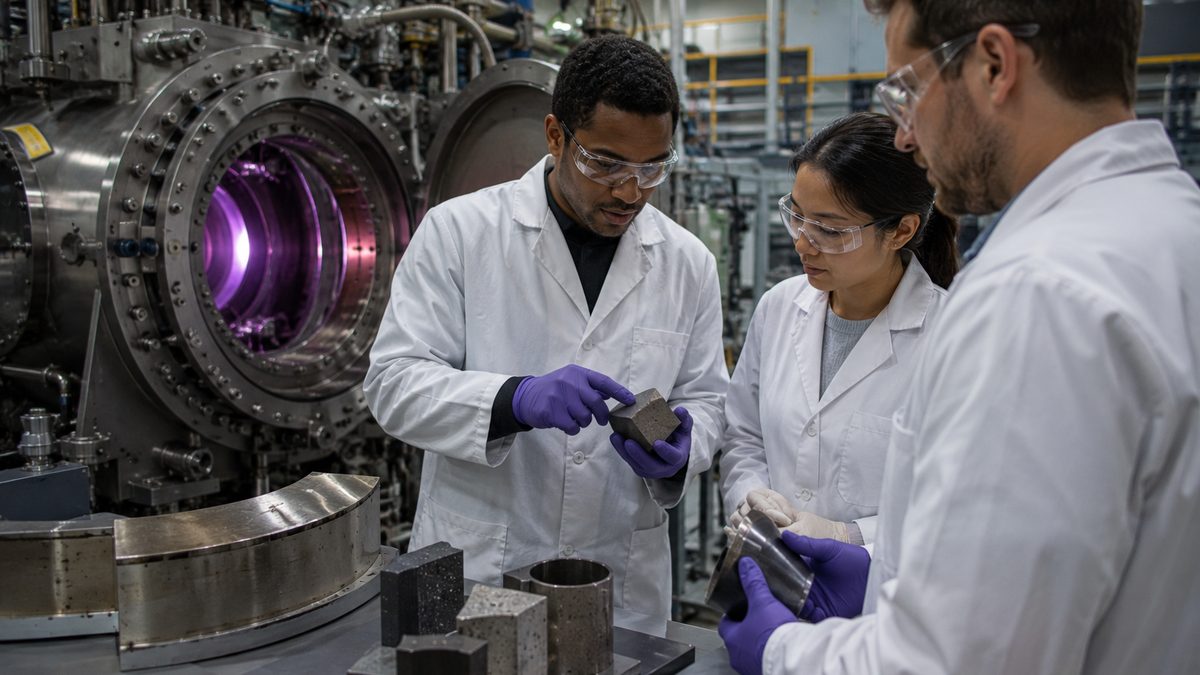
Fusion research depends on plasma physics, materials science, engineering and advanced computing. Editorial illustration by TheDailyGlobe.
Key Facts
- Fusion is the process of combining light atoms to release energy, similar to the reaction that powers stars.
- DOE describes fusion research as depending on plasma physics, materials science, engineering and advanced computing.
- A practical fusion system must control plasma hot enough to challenge the materials around it.
- Temperature, confinement and machine durability are separate problems that all have to work together.
- Current research is still focused on solving major scientific and engineering barriers, not proving that commercial fusion is ready now.
Fusion power sounds simple when reduced to its basic idea: combine light atoms, release energy, and use that energy to make electricity. The reaction is the same broad process that powers the Sun and other stars. The fuel can sound ordinary compared with the scale of the promise.
The hard part is everything around the reaction. A power plant would need to create and control an ultra-hot plasma, keep it stable long enough to produce useful energy, capture that energy, and protect the machine from conditions far beyond normal industrial heat.
That gap between making fusion happen and building a practical fusion power plant is the real story. The U.S. Department of Energy describes fusion research as work that depends on plasma physics, materials science, engineering and advanced computing. In other words, the fuel may be simple, but the system around it is not.
The Reaction Is Known. The Control Is the Problem.
Fusion is not mysterious because scientists do not know what the reaction is. The basic physics has been studied for decades. The central challenge is getting the reaction to happen in a controlled way that can eventually produce more useful energy than the system takes to run.
That requires plasma, a state of matter in which gas becomes so hot that electrons separate from atoms. Plasma is not a normal fuel sitting calmly in a tank. It is electrically charged, extremely hot and difficult to confine.
Researchers have to keep that plasma away from the walls of the machine while also maintaining the conditions needed for fusion. If the plasma cools, becomes unstable or touches the wrong surfaces, the reaction cannot be sustained in the way a power plant would need.
Why Temperature and Confinement Matter
Fusion requires extreme temperatures because atomic nuclei normally repel each other. To overcome that repulsion, the fuel has to be heated into a plasma hot enough for nuclei to collide and fuse.
Getting the plasma hot is only part of the challenge. The plasma also has to be confined. In many fusion experiments, magnetic fields are used to shape and hold the charged plasma so it does not simply hit the surrounding machine.
That is a delicate task. A useful fusion system cannot just create a burst of fusion and stop. It needs a way to manage plasma behavior, heat, fuel, exhaust and energy capture together. This is where fusion moves from elegant physics into difficult engineering.
The Machine Has to Survive the Star-Like Conditions
One of the biggest barriers is not only the plasma itself, but the materials near it. Oak Ridge National Laboratory has highlighted the problem of keeping plasma hotter than the Sun from damaging machine components.
That phrase points to a practical issue. Even if magnetic fields keep the hottest plasma away from the walls, parts of a fusion machine still have to handle intense heat, particles and long-term stress. Components may need to survive conditions that ordinary materials were never built to endure.
This is why materials science is central to fusion. Researchers need to understand which materials can tolerate the environment near the plasma, how they change over time, and how a future machine could be maintained without constant breakdowns.
What Researchers Are Testing Now
Fusion research is not one single problem waiting for one breakthrough. It is a stack of connected problems. Plasma behavior has to be modeled and controlled. Materials have to be tested. Engineering systems have to remove heat, handle fuel and protect the structure.
DOE's Fusion Energy Sciences program supports work across those areas, including plasma physics and the science needed for future fusion energy systems. Princeton Plasma Physics Laboratory and other research institutions focus on understanding and controlling plasma, while facilities such as Oak Ridge's materials-focused efforts examine how fusion components may perform under harsh conditions.
Advanced computing also matters because fusion machines involve many interacting variables. Scientists use models and experiments together to study how plasma behaves and how materials respond, then test those ideas in real equipment.
Why Simple Fuel Does Not Mean Simple Power
The public often hears about fusion as a future energy source and naturally asks why it is not here yet. The answer is that creating fusion conditions is different from building a dependable power plant.
A power plant has to operate repeatedly, safely and economically. It has to convert energy into electricity, protect its components, manage repairs and run under rules that make sense outside a research setting. A promising experiment can answer one question without solving all of those.
That does not make fusion research empty promise. It means the timeline should be described carefully. The science has made real progress, but commercial-ready fusion still depends on solving practical problems that are as physical as they are theoretical.
The best way to understand fusion is not as a magic energy shortcut, but as an attempt to build a machine around one of nature's most demanding reactions. The fuel may be simple. Holding a star-like plasma long enough to make useful electricity without destroying the machine around it is the part that makes fusion so hard.
Reporting note: Reporting draws on U.S. Department of Energy materials, DOE Office of Science fusion resources, Oak Ridge National Laboratory materials, Princeton Plasma Physics Laboratory resources, and reviewed energy science context. This article was produced with AI-assisted research and reviewed by an editor before publication.