What Would Actually Happen if Earth's Magnetic Poles Flipped?
Earth's magnetic field has reversed many times over millions of years. Scientists say it is a natural process—not the sudden global catastrophe often portrayed online.
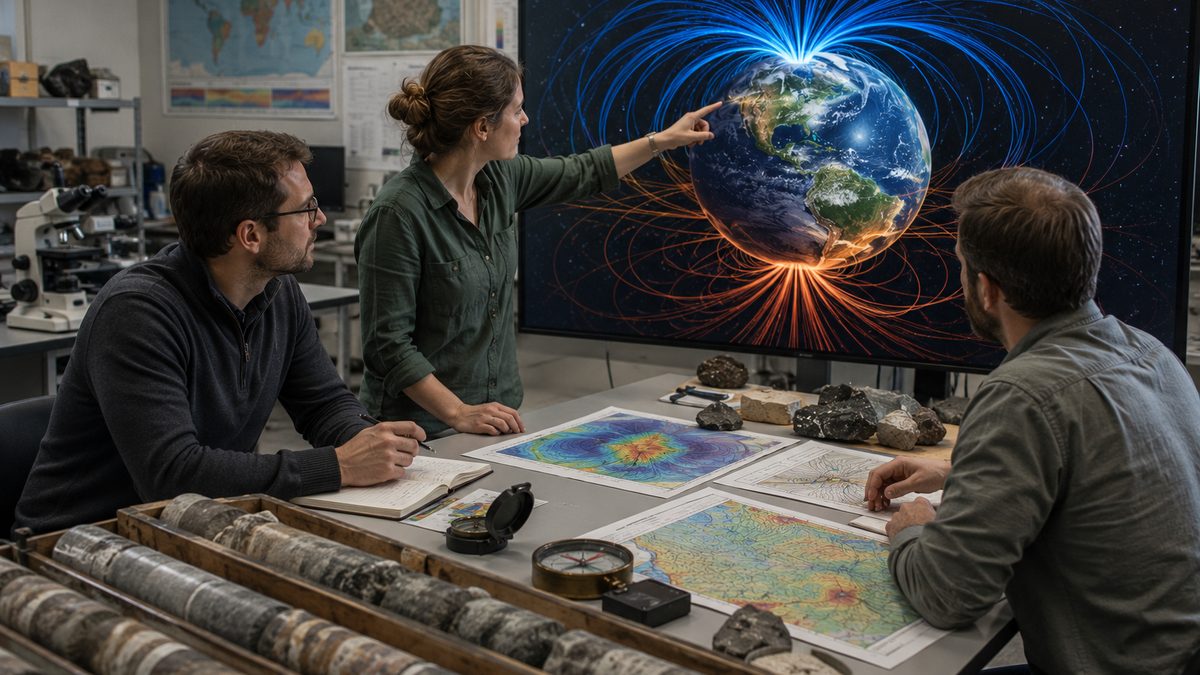
Scientists study Earth's magnetic field using observations, satellite data, and evidence preserved in ancient rocks. Editorial illustration by TheDailyGlobe.
Key Facts
- Earth's magnetic field is created by the movement of molten iron deep inside the planet.
- Magnetic north slowly changes position over time and is different from the geographic North Pole.
- Geologic evidence shows Earth's magnetic field has reversed many times over millions of years.
- Scientists have no evidence that a magnetic reversal causes immediate global extinction events.
- A future reversal could require adjustments for satellites, navigation systems, and space-weather forecasting, but it would not flip the planet upside down.
Stories claiming Earth's magnetic poles are about to flip often spread quickly online, usually accompanied by predictions of global disasters, mass extinctions, or the collapse of modern civilization. The science tells a much calmer story. Earth's magnetic field has reversed many times throughout the planet's history, and while a future reversal would present challenges for technology and scientific monitoring, experts do not consider it an instant apocalypse.
What Earth's Magnetic Field Actually Does
Earth behaves like a giant magnet because liquid iron circulates within its outer core. That constant motion generates the magnetic field that surrounds the planet. The field helps shield Earth from charged particles streaming from the Sun and plays an important role in protecting satellites, astronauts, and some technologies from the effects of space weather.
The magnetic field also allows compasses to work. Rather than pointing toward the geographic North Pole, a compass points toward magnetic north, which slowly shifts over time as Earth's magnetic field changes.
A Moving Pole Is Not the Same as a Pole Reversal
Magnetic north is constantly moving. NOAA tracks these changes because accurate magnetic models are important for navigation, aviation, shipping, and mapping. The gradual movement of magnetic north is a normal part of how Earth's magnetic field behaves and should not be confused with a magnetic reversal.
A magnetic reversal is a much larger event in which Earth's magnetic north and south poles gradually exchange places. This process unfolds over thousands of years rather than days or weeks. During that time, the magnetic field may become more complicated and temporarily weaker in some regions before stabilizing again.
How Scientists Know Reversals Happened
No human has witnessed a complete magnetic reversal, but geologists have strong evidence that they have occurred repeatedly throughout Earth's history. As volcanic rock cools, tiny magnetic minerals align with the direction of Earth's magnetic field at that moment. Those minerals preserve a record of the field's orientation, creating a timeline that scientists can study millions of years later.
Researchers have also found matching magnetic patterns preserved on the seafloor as new ocean crust formed over time. Together, these records provide compelling evidence that magnetic reversals are a recurring feature of Earth's geologic history rather than an unusual or unprecedented event.
What Would Change During a Future Reversal?
If another reversal eventually occurs, scientists expect the greatest challenges to involve technology rather than the planet itself. A weaker or more complex magnetic field could allow more charged particles from space to reach areas closer to Earth, increasing concerns for satellites, spacecraft, high-altitude aviation, and some electrical infrastructure during major solar storms.
Navigation systems that rely on magnetic headings would also require updated maps and calibration as magnetic north continued to shift. These adjustments already occur today because magnetic north naturally moves over time, although a reversal would likely require more extensive updates.
Separating Science From Online Myths
Perhaps the biggest misconception is that a magnetic reversal means Earth's geographic poles suddenly switch places. They do not. The planet would not flip upside down, continents would not rapidly move, and oceans would not suddenly rush across the globe. Geographic north and south are determined by Earth's axis of rotation, while magnetic north and south are produced by processes deep inside the planet's core.
Scientists also emphasize that there is no evidence an imminent magnetic reversal is underway or that one would instantly destroy life on Earth. Earth's magnetic field naturally changes over time, and researchers continue monitoring those changes to better understand how the planet works. Rather than signaling an approaching catastrophe, the movement of Earth's magnetic field offers scientists another window into the dynamic processes occurring thousands of miles beneath our feet.
Reporting note: Reporting draws on NOAA National Centers for Environmental Information, NASA educational materials, U.S. Geological Survey publications, and reviewed background information. This article was produced with AI-assisted research and reviewed by an editor before publication.