What Would Actually Happen if You Got Too Close to a Black Hole?
Black holes do not suck up everything nearby, but extreme gravity near one can distort time, stretch matter and create a boundary where light can no longer escape.
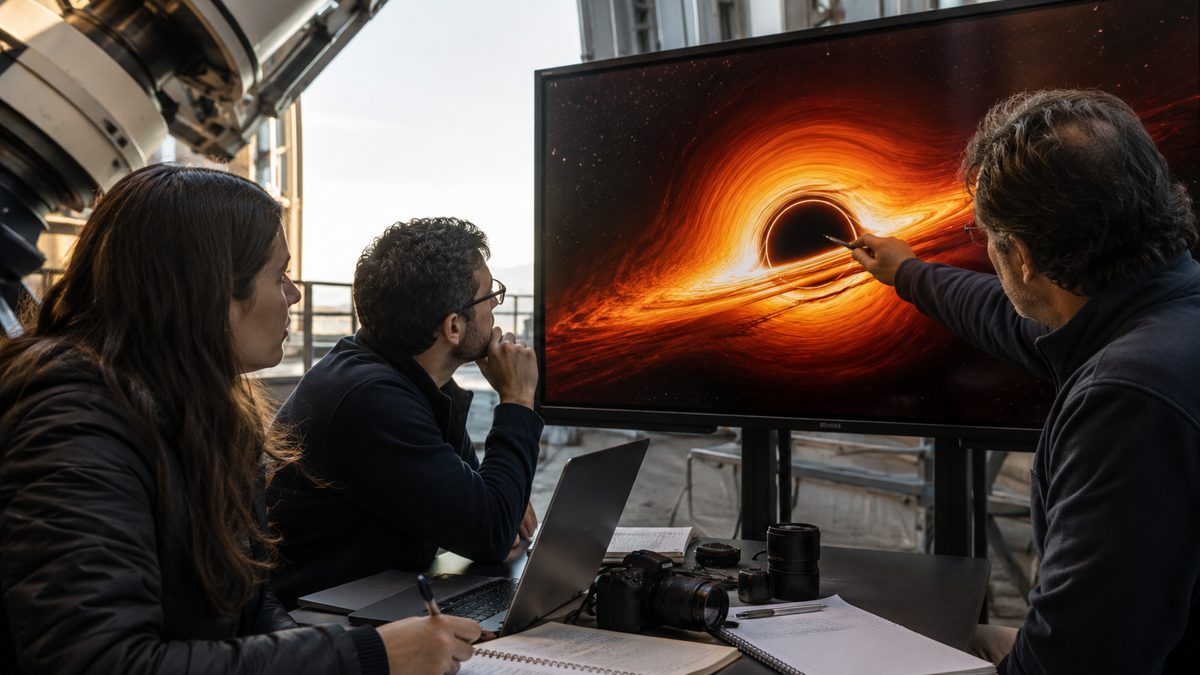
Scientists study black holes by observing how extreme gravity affects nearby matter and light. Editorial illustration by TheDailyGlobe.
Key Facts
- A black hole is not a cosmic vacuum cleaner; objects can orbit one if they remain far enough away.
- The event horizon is the boundary past which light cannot escape.
- Tidal forces near a black hole can stretch objects because gravity pulls much harder on the nearer side than the farther side.
- Gas and dust near a black hole can heat into a bright accretion disk before crossing the event horizon.
- Smaller black holes can create stronger stretching near the event horizon than supermassive black holes.
Black holes have a reputation for being monsters of space, but the real physics is stranger and more interesting than the movie version. A black hole does not roam around like a cosmic vacuum cleaner, swallowing everything in the neighborhood. If something keeps a safe distance, it can orbit a black hole much like objects orbit other massive bodies.
The danger begins when an object gets too close. Near a black hole, gravity becomes so extreme that space, time and matter stop behaving the way they do in everyday life. Gas can heat into a glowing disk. Light can bend. Time can appear distorted from far away. And past a boundary called the event horizon, not even light can escape.
That is what makes black holes so hard to study and so fascinating. Scientists do not see the black hole itself in the ordinary sense. NASA explains black holes by their effects on nearby matter and light, including the behavior of gas, stars and radiation around them.
What Too Close Really Means
Too close does not mean simply being in the same galaxy as a black hole. It means reaching a region where the black hole's gravity dominates the motion and fate of nearby matter.
At a distance, a black hole's gravity can act like the gravity of any other very massive object. If the sun were somehow replaced by a black hole with the same mass, Earth would not suddenly be sucked away; it would continue orbiting the same mass. The problem is not magic suction. The problem is extreme gravity packed into a very small region.
As an object moves closer, the difference in gravity between the side facing the black hole and the side facing away can become enormous. That difference is what creates tidal forces.
How Gravity Can Stretch Matter
Tidal forces are not unique to black holes. The moon's gravity helps raise tides on Earth because it pulls a little more strongly on the side of Earth facing the moon than on the far side. Near a black hole, that same basic idea becomes extreme.
If an object falls close enough, gravity can pull much harder on the part nearest the black hole than on the part farther away. That stretching effect is often called spaghettification. The word sounds cartoonish, but the physics is serious: matter can be pulled into long, thin streams by uneven gravity.
The size of the black hole matters. Around smaller black holes, the tidal forces near the event horizon can be much stronger. Around supermassive black holes, the event horizon is larger, and the stretching at that boundary can be less extreme at first, though the final outcome past the horizon is still inescapable.
Why Black Holes Can Glow Around the Edges
A black hole itself does not shine. But the matter around it can become extremely bright. Gas and dust falling toward a black hole can form an accretion disk, a flattened, swirling structure heated by friction and gravity.
That disk can glow intensely before material crosses the event horizon. In many cases, it is the surrounding matter that lets astronomers study the black hole's presence. The light, heat and motion around the black hole reveal what gravity is doing.
This is also why the phrase black hole can be misleading for casual readers. The dark center may be impossible for light to escape, but the region around it can be one of the brightest and most energetic places in the universe.
The Point Where Escape Ends
The event horizon is the boundary that gives a black hole its defining feature. Once something crosses it, escape is no longer possible, not because the object lacks a strong enough engine, but because the structure of space and time points inward. Light itself cannot get out.
From far away, the fall toward a black hole can appear distorted by gravity's effect on light and time. Close to the event horizon, the difference between what an outside observer sees and what a falling object experiences becomes part of the strange reality of relativity.
That does not mean a black hole is unknowable. It means scientists learn from what happens around the boundary: the motion of stars, the heating of gas, the bending of light and the signals from matter under extreme gravity.
What Readers Should Remember
The simple version is this: black holes are not space vacuums, but they are regions where gravity becomes extreme enough to change the rules for nearby matter and light. Getting too close can mean being stretched by tidal forces, swept into a hot accretion disk, or crossing an event horizon from which nothing can return.
The science remains active because black holes give researchers a way to test gravity under conditions that cannot be created on Earth. The next time a black hole headline sounds like horror, the better question is not whether it is coming to swallow everything. It is what nearby matter and light are showing scientists about gravity at its most extreme.
Reporting note: Reporting draws on NASA Science materials, black hole explainers, reviewed astronomy context, and science background on tidal forces and event horizons. This article was produced with AI-assisted research and reviewed by an editor before publication.