What Would Actually Happen if an Asteroid Was Headed Toward Earth?
Planetary defense is less like a disaster movie and more like a careful system of sky surveys, probability updates, mission planning and public warnings.
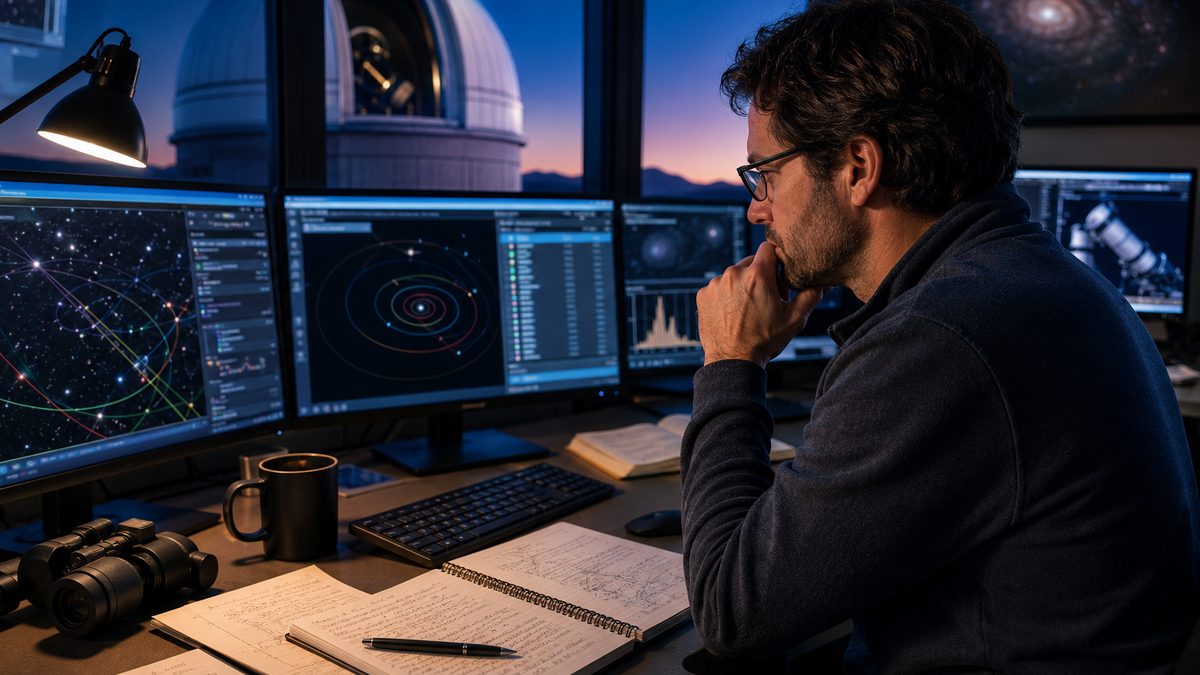
Planetary defense relies on detection, tracking, probability updates, and preparation long before any possible asteroid impact. Editorial illustration by TheDailyGlobe.
Key Facts
- Planetary defense begins with detecting and tracking near-Earth objects over time.
- Impact probability is updated as astronomers collect more observations and narrow an asteroid's path.
- Warning time depends on when the object is discovered, its size, its orbit and how close it comes to Earth.
- NASA's DART mission demonstrated that a spacecraft impact can change an asteroid's motion in space.
- Evacuation or emergency planning would depend on the predicted impact area, object size and available warning time.
Asteroid stories usually arrive with a movie-sized question: what if one was headed straight for Earth?
The real answer is calmer, more technical and more useful than the disaster version. Planetary defense starts with finding objects in space, tracking their paths, updating impact probabilities and deciding what kind of response fits the size, timing and location of the possible threat.
NASA, the European Space Agency and other space organizations already watch for near-Earth objects. The hard part is not only seeing an asteroid. It is figuring out whether it truly poses a risk, how much warning time exists and whether the right response is more observation, public preparation, evacuation planning or a spacecraft mission.
Who Would Know First
In most realistic cases, the first warning would come from astronomers and automated sky surveys that search for objects moving against the background of stars. Observatories collect images, software flags moving points of light, and follow-up observations help determine whether the object is a known asteroid or a new one.
That early stage can be uncertain. A newly detected object may have only a short observation record, which means scientists may not yet know its orbit precisely. The first public numbers can change as more data arrives.
That is why an early impact probability should not be treated as a final answer. A small probability can rise or fall after additional observations. Often, better tracking reduces uncertainty and rules out an impact. The process is built around updating the risk as the evidence improves.
How Warning Timelines Work
The amount of warning would depend on the asteroid. Some objects are discovered long before they come close to Earth. Others, especially smaller objects, may be detected much later because they are faint, fast-moving or approaching from a difficult direction.
A long-warning scenario gives officials and scientists more options. Years of notice could allow for detailed tracking, international planning and possibly a deflection mission. Months or weeks of warning would narrow the choices. Very short warning might make local emergency action more important than any attempt to change the object's path.
Size matters, too. A small asteroid can still be dangerous if it explodes in the atmosphere or reaches the ground, but it is not the same problem as a much larger object. Planetary defense decisions depend on the expected energy, location, timing and uncertainty, not just the dramatic fact that an asteroid exists.
What DART Proved
NASA's Double Asteroid Redirection Test, known as DART, was designed to test whether a spacecraft could change an asteroid's motion by crashing into it. Johns Hopkins Applied Physics Laboratory played a central role in the mission.
The mission did not involve an asteroid threatening Earth. That was the point. It was a controlled test of a possible planetary defense technique before an emergency required one.
DART showed that a kinetic impact can alter an asteroid's path. In practical terms, that means humans have demonstrated one way to nudge a space rock. But it does not mean every asteroid could be handled the same way. The usefulness of any deflection mission would depend on warning time, asteroid size, composition, orbit and how accurately the mission could be planned.
Why Probability Matters More Than Panic
A common myth is that scientists either know an asteroid will hit Earth or they do not. The reality is more gradual.
When an object is first spotted, its future path may include a range of possibilities. With more observations, that range narrows. Sometimes Earth is inside the early uncertainty zone. Later, as the orbit becomes clearer, Earth may fall outside it.
That is one reason asteroid reports can sound alarming before becoming less concerning. The change does not always mean scientists were wrong. It often means they gathered more data.
Another myth is that planetary defense would be a last-minute mission with one desperate launch. In reality, the best-case response depends on early detection. A small change made years in advance can matter far more than a dramatic effort made too late.
When Evacuation Could Matter
If an asteroid were too small, too late or too close for deflection, emergency planning could become the practical response. That does not always mean a global disaster. Depending on the object, the concern could be regional airburst damage, coastal effects, falling debris or a smaller impact zone.
Evacuation planning would depend on where the object was expected to hit, how certain the prediction was and how much time remained. Officials would need to weigh the risk of the impact against the risks of moving people, closing roads, disrupting services and issuing warnings under uncertainty.
That is why communication would be central. People would need clear information about what is known, what is uncertain, what area is at risk and what action is actually recommended. Bad information could create its own danger.
What Remains Unclear
Planetary defense has improved, but it is not a magic shield. Scientists are still working on better detection, better tracking, better modeling and a clearer understanding of how different asteroid types would respond to deflection attempts.
The practical takeaway is not that people should worry about asteroids every day. It is that asteroid defense is a real field with real tools, tested methods and serious limits. The earlier a hazardous object is found, the more choices humanity has.
If a concerning asteroid were discovered, the most important questions would be specific: how big is it, how certain is the orbit, when could it arrive, where could it go, and how much warning time exists? Planetary defense begins by answering those questions carefully, not by treating the sky like a movie trailer.
Reporting note: Reporting draws on NASA planetary defense materials, European Space Agency planetary defense information, Johns Hopkins Applied Physics Laboratory materials, DART mission research, and reviewed background materials. This article was produced with AI-assisted research and reviewed by an editor before publication.