Webb Finds Hydrocarbons in the Atmosphere of a Planet Orbiting a Dead Star
A new study reports hydrocarbons and aerosols in the atmosphere of a planet orbiting a white dwarf, giving scientists a rare look at planetary chemistry after a star dies.
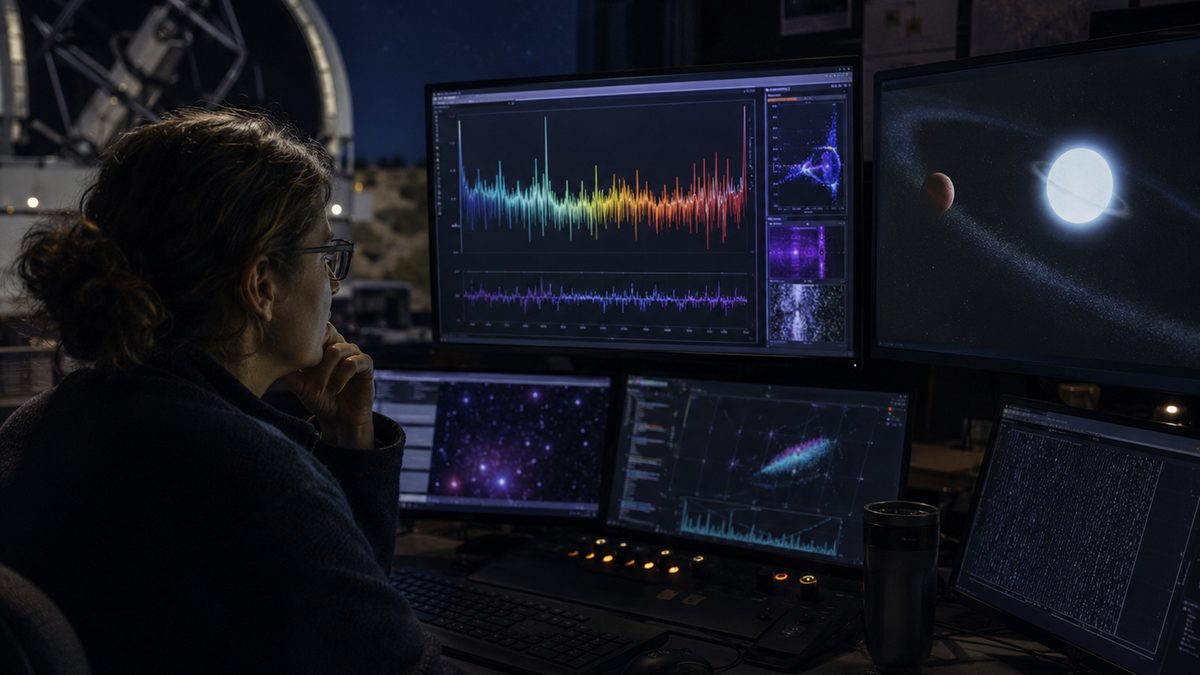
Webb spectroscopy is helping scientists study the atmosphere of a planet orbiting a white dwarf star. Editorial illustration by TheDailyGlobe.
Key Facts
- A Nature study published July 1, 2026, reports aerosols and hydrocarbons in the atmosphere of a white dwarf planet.
- A white dwarf is the dense remnant left after a star like the Sun exhausts its fuel and sheds its outer layers.
- NASA describes Webb as a major space observatory designed to study the universe with infrared instruments.
- Webb spectroscopy can help scientists identify chemical signatures in distant atmospheres.
- The finding does not prove biology, habitability or alien life.
A star's death does not necessarily end the story of the planets around it. Long after a star has burned through its main life and collapsed into a dense remnant, scientists can still look for clues about what survived, what changed and what new chemistry may be happening nearby.
A new Nature study reports aerosols and hydrocarbons in the atmosphere of a planet orbiting a white dwarf, using observations connected to the James Webb Space Telescope. The finding does not prove life, and it should not be framed that way. Its value is more careful and still striking: Webb can help scientists study the chemistry of a planet around a dead star.
What a White Dwarf Is
A white dwarf is what remains after certain stars reach the end of their normal lives. A star like the Sun does not explode as a supernova. Instead, after a long evolution, it sheds its outer layers and leaves behind a hot, dense core. That leftover core is the white dwarf.
For planets, that kind of stellar aging can be violent. Orbits can change. Atmospheres can be stripped or altered. Some worlds may be destroyed, while others may survive in changed form. That is why planets around white dwarfs are scientifically interesting: they can offer clues about what planetary systems look like after their stars are no longer shining in the familiar way.
The idea also has a long view that is easy for readers to understand. Our own Sun will eventually leave its main life behind. Studying planets around white dwarfs gives scientists a way to examine the later chapters of planetary systems, even if the details vary from system to system.
Why Webb Can See More Than a Point of Light
The James Webb Space Telescope is not simply taking pictures of faraway planets. NASA describes Webb as a major space observatory built to study the universe with infrared instruments. One of its most important tools is spectroscopy, which separates light into different wavelengths.
That matters because chemicals can leave patterns in light. When starlight or planetary light carries those patterns, scientists can use spectroscopy to look for signs of molecules or particles in an atmosphere. The result is not a snapshot in the ordinary sense. It is closer to a chemical fingerprint.
For a planet orbiting a white dwarf, that kind of measurement is especially useful. The world is distant, the star is faint compared with many living stars and the atmosphere is not something scientists can sample directly. Webb's instruments can help turn faint light into clues about what is present above the planet's surface.
What Hydrocarbons and Aerosols Suggest
The Nature study reports hydrocarbons and aerosols in the atmosphere. Hydrocarbons are molecules made of hydrogen and carbon. Aerosols are small particles or droplets suspended in an atmosphere. On different worlds, both can be connected to chemistry driven by light, heat, atmospheric mixing or other environmental conditions.
The important point is that these materials are chemical clues, not conclusions by themselves. On Earth, some hydrocarbons may be associated with living systems or human activity, but hydrocarbons can also form through non-biological processes. In planetary science, the presence of a molecule does not automatically explain how it got there.
That is why the finding should be treated as atmospheric chemistry, not an alien-life headline. Scientists are trying to understand what the planet's atmosphere contains and what that may say about conditions around a white dwarf. The data can support better questions about planetary survival, atmospheric change and chemistry after stellar death.
What the Finding Does Not Prove
The study does not establish that the planet is habitable. It does not show that living things are present. It does not mean the atmosphere is Earth-like. It also does not answer every question about how the hydrocarbons or aerosols formed.
That restraint matters because exoplanet discoveries can easily be pushed into familiar speculation. A planet around a dead star with atmospheric chemistry is fascinating enough without adding claims the evidence does not support. The confirmed point is that scientists reported hydrocarbons and aerosols and that Webb's observing power helped make the atmosphere possible to study.
There are also limits to what one study can settle. Scientists will need to compare the finding with models, additional observations and other planetary systems. They will need to test which chemical pathways best explain what Webb detected.
Why This Matters Beyond One Planet
The broader lesson is that planets around white dwarfs are not just astronomical leftovers. They can be laboratories for studying how planetary atmospheres change under unusual conditions, how systems survive after stellar aging and what kinds of chemistry can exist in environments very different from our own.
That makes the discovery useful even for readers who do not follow exoplanet research closely. It shows how modern telescopes can study worlds not as dots, but as places with atmospheres that carry chemical information. Webb's work is helping move astronomy from finding planets to asking what those planets are like.
The next thing to watch is whether additional Webb observations or follow-up studies confirm the chemical picture and explain how the hydrocarbons and aerosols formed. For now, the finding offers a careful but compelling reminder: even around a dead star, planetary chemistry can still have a story to tell.
Reporting note: Reporting draws on a Nature study on aerosols and hydrocarbons in the atmosphere of a white dwarf planet, NASA Webb mission science materials, and reviewed background context. This article was produced with AI-assisted research and reviewed by an editor before publication.