Octopuses May Be the Closest Thing on Earth to an Alien Kind of Intelligence
Octopuses evolved intelligence along a completely different evolutionary path than mammals, giving scientists a rare opportunity to study how complex minds can develop in surprisingly different ways.
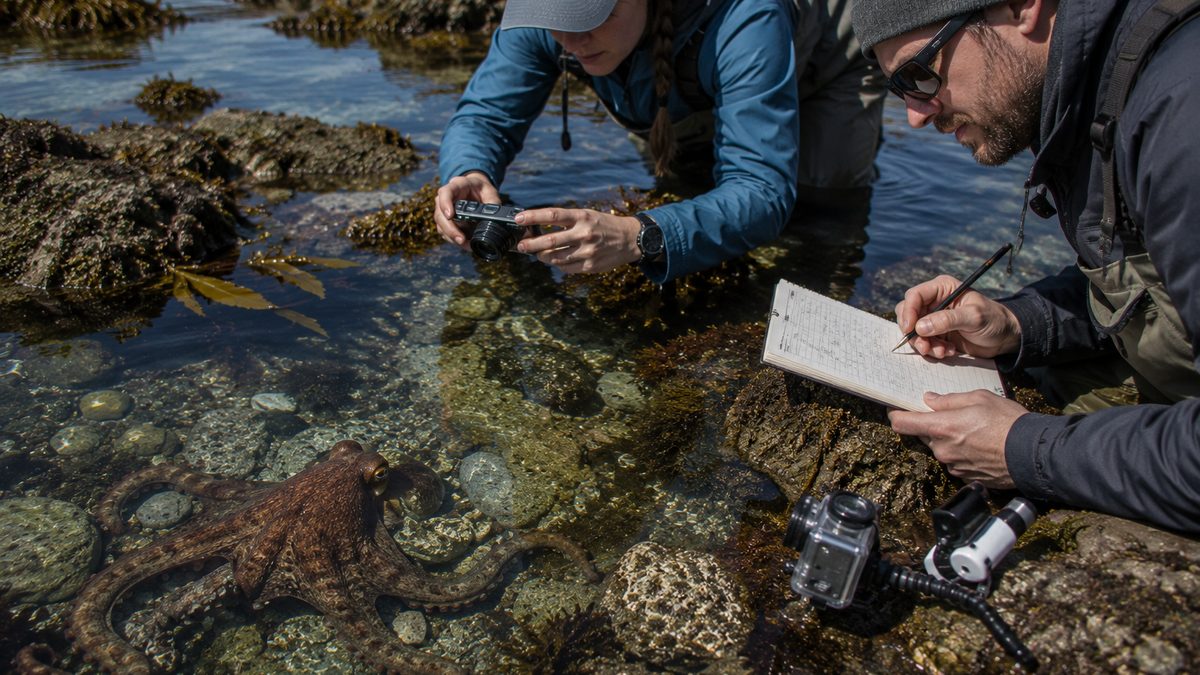
Researchers study octopus behavior to better understand one of the most unusual nervous systems in the animal kingdom. Editorial illustration by TheDailyGlobe.
Key Facts
- Octopuses evolved intelligence independently from mammals over hundreds of millions of years of evolution.
- Roughly two-thirds of an octopus's neurons are located in its arms rather than its central brain.
- Each arm can process information and coordinate movement with considerable independence.
- Researchers describe octopus behavior as an example of distributed intelligence rather than human-style thinking.
- Scientists caution that octopus intelligence is extraordinary but should not be mistaken for human consciousness.
An octopus squeezing through a hole barely larger than its eye, unscrewing the lid of a jar, changing color in an instant, or exploring an unfamiliar object with eight flexible arms can seem almost impossible to believe. Its behavior often feels so unusual that people describe it as alien. Scientists use that comparison for a different reason. Octopuses did not inherit their intelligence from the same evolutionary path that produced humans, dogs, dolphins, or other mammals. Instead, they arrived at complex problem-solving through a remarkably different kind of nervous system.
A Very Different Kind of Brain
Most people think of intelligence as something controlled almost entirely by the brain. In mammals, that is largely true. An octopus works differently. While it has a central brain between its eyes, much of its nervous system is distributed throughout its eight arms. Each arm contains large bundles of neurons that help control movement, touch, and exploration without requiring every action to be directed from the central brain.
Researchers sometimes describe this arrangement as distributed intelligence. That does not mean each arm has a separate mind. Instead, the nervous system shares responsibility across the body, allowing the animal to perform several complicated tasks at once while reducing the burden on the central brain.
Why Their Behavior Seems So Unusual
Octopuses regularly demonstrate behaviors that capture scientists' attention. They investigate unfamiliar objects, solve simple puzzles, navigate mazes, manipulate containers, escape enclosures, and use camouflage that responds rapidly to changes in their surroundings. Much of this behavior relies on sensory information gathered through the arms themselves, which are covered with suction cups capable of detecting both touch and chemical signals.
Because each arm can react to local information while remaining connected to the rest of the nervous system, an octopus can inspect multiple parts of its environment simultaneously. To human observers, those coordinated but flexible movements often appear almost improvisational.
An Independent Path to Intelligence
Humans, whales, birds, and many other intelligent animals all belong to evolutionary branches that share distant common ancestors with complex nervous systems. Octopuses belong to an entirely different branch of the animal kingdom. Their last common ancestor with humans lived hundreds of millions of years ago and likely possessed nothing resembling today's sophisticated brains.
That long evolutionary separation makes octopuses especially valuable to researchers. Their intelligence demonstrates that complex problem-solving abilities can emerge through very different biological designs rather than following a single evolutionary blueprint.
What Scientists Are Still Learning
Modern neuroscience continues to explore how octopus brains and arms cooperate during learning, movement, and decision-making. Researchers are studying how information flows throughout the nervous system and how flexible arm control contributes to behaviors that appear surprisingly adaptable. New findings continue to reshape scientists' understanding of how intelligence can function outside the mammalian model.
Even so, researchers urge caution when interpreting octopus behavior. Solving puzzles or escaping containers does not necessarily mean an octopus thinks exactly as a person would. Scientists generally avoid describing them as miniature humans or suggesting they possess human-style consciousness. Instead, they focus on understanding intelligence on its own evolutionary terms.
Expanding Our Definition of Intelligence
The greatest lesson from octopus research may be that intelligence does not have a single design. Evolution has produced many ways of sensing the world, solving problems, and adapting to changing environments. Octopuses remind scientists that sophisticated behavior can emerge from nervous systems organized very differently from our own.
That realization is one reason octopuses continue to fascinate researchers and the public alike. Their abilities do not suggest they are literally alien, but they do reveal just how inventive evolution can be. By studying these remarkable animals, scientists are expanding our understanding of what intelligence can look like—and discovering that the familiar human model may be only one of many successful solutions nature has produced.
Reporting note: Reporting draws on Nature reporting, cephalopod neuroscience research, Ars Technica reporting on cephalopod nervous systems, and reviewed background materials. This article was produced with AI-assisted research and reviewed by an editor before publication.