The Ocean Twilight Zone Helps Control Earth's Carbon, and Most People Never See It
The ocean twilight zone is a dim mid-water world where fish, plankton and daily migrations help move carbon from the surface into the deep sea.
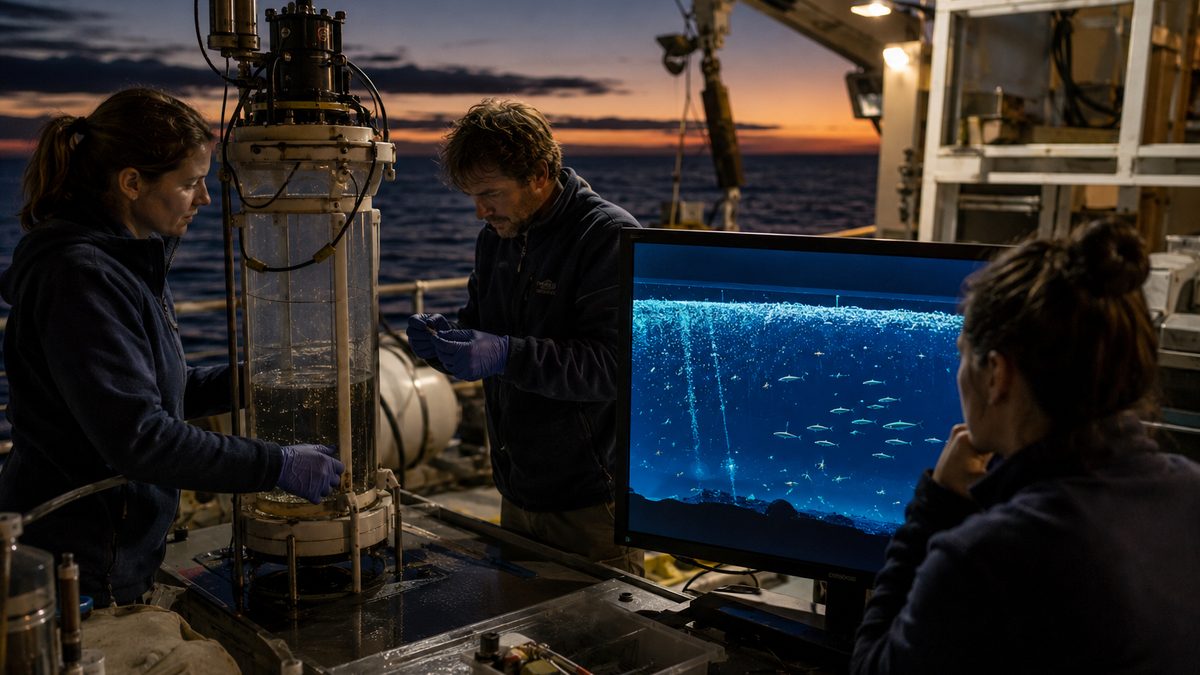
The ocean twilight zone helps move carbon from surface waters into the deep ocean. Editorial illustration by TheDailyGlobe.
Key Facts
- The ocean twilight zone is a mid-water region where sunlight fades but marine life remains active.
- NOAA describes the twilight zone as important to moving carbon from surface waters into the deep ocean.
- Plankton, fish, squid and other organisms help move carbon downward through feeding, migration and waste.
- The biological pump is the process that helps transfer carbon from the surface ocean into deeper waters.
- Scientists are still studying how fishing, climate change and ecosystem shifts may affect twilight-zone carbon movement.
Far below the bright surface of the ocean, there is a dim layer most people will never see. Sunlight fades there, but life does not. Fish, squid, plankton and other organisms move through the water in patterns that help shape the planet's carbon cycle.
Scientists call it the ocean twilight zone, a mid-water region between the sunlit surface and the deep ocean. It is not as familiar as coral reefs or beaches, but it plays a quiet role in how carbon moves through Earth's largest ecosystem.
NOAA describes the twilight zone as a place where organisms help move carbon from surface waters into the deep ocean. That matters because carbon that sinks or is carried downward can be stored away from the atmosphere for long periods, though scientists are still working to measure exactly how much moves through this hidden system.
Where the Twilight Zone Begins
The ocean's surface layer is full of sunlight. That light supports phytoplankton, the tiny plant-like organisms that use photosynthesis and form the base of many marine food webs. As depth increases, sunlight weakens. Eventually, there is not enough light for photosynthesis to continue in the same way.
The twilight zone sits below that bright surface layer. It is dim, cold and difficult to study, but it is not empty. Many animals spend time there, and some move up and down each day. At night, organisms rise toward the surface to feed. During the day, many move deeper again.
That daily movement is one reason the twilight zone matters. It connects the surface ocean, where carbon is taken up by plankton, to deeper waters where carbon may remain for much longer.
How Life Moves Carbon Downward
Carbon enters the ocean in many ways, including through the growth of phytoplankton near the surface. When organisms feed, produce waste, die or are eaten, some of that carbon begins moving downward.
The twilight zone helps carry that process farther. Small organisms and particles sink. Fish and other animals feed near the surface, then return to deeper water. Waste and organic matter can descend into the ocean's interior. Together, these movements help transfer carbon away from the surface.
Scientists often describe this as part of the biological pump. The phrase can sound mechanical, but the process is alive: plankton growing, animals feeding, fish migrating, particles falling and deep-ocean ecosystems recycling material in ways that connect biology to climate.
Why the Deep Ocean Matters to Climate
The ocean is central to Earth's carbon system because it can take up and store large amounts of carbon. The twilight zone is one part of that larger ocean carbon story.
When carbon stays near the surface, it can cycle back more quickly through the atmosphere and upper ocean. When it moves into deeper water, it can be stored for longer periods. That does not make the twilight zone a simple climate solution, and scientists do not describe it as a switch that can be turned on or off. It is a natural system with many moving parts.
Understanding that system matters because changes in ocean temperature, food webs, oxygen levels, fishing pressure or plankton communities could affect how carbon moves. A small change in a huge ocean process can matter, but measuring that change is difficult.
Fishing and Food Web Questions
The twilight zone is also drawing attention because it contains marine life that could be affected by fishing and other human activity. Scientists are interested in how removing organisms from the twilight zone might change food webs and carbon movement.
The concern is not only about one species or one fishing decision. It is about the role these organisms play in a larger system. If fish and other animals help move carbon downward, then changing their numbers could affect more than the immediate catch.
At the same time, scientists have to be careful. The twilight zone is vast, uneven and hard to observe. Its organisms are not distributed the same way everywhere, and their role in carbon movement can vary by region, season and ecosystem.
What Remains Hard to Measure
The biggest challenge is that the twilight zone is difficult to study directly. It is deep enough to be hard to reach, large enough to resist simple measurement and dynamic enough that conditions can change over time.
NASA and NOAA-supported work on ocean carbon tracking reflects why scientists need better observations and models. Researchers can study particles, plankton, ocean chemistry, animal movement and satellite-connected surface conditions, but no single measurement captures the full system.
That uncertainty is important. Scientists know the twilight zone helps move carbon and supports major food-web activity. What remains harder to pin down is exactly how much carbon it moves, how long that carbon stays stored, and how climate change or fishing could alter the process.
The hidden-world appeal of the twilight zone is real, but so are the stakes. A dim layer of ocean filled with small organisms and daily migrations helps connect marine life to Earth's carbon balance. The next question is how well scientists can measure it before human activity and a changing climate alter what is happening in the dark.
Reporting note: Reporting draws on NOAA materials, NASA ocean carbon research, Woods Hole Oceanographic Institution materials, and reviewed marine science context. This article was produced with AI-assisted research and reviewed by an editor before publication.