NOAA Is Tracking Ocean Acidification From Coast to Coast
NOAA research missions are measuring changing ocean chemistry, a science issue that can affect shellfish, fisheries, reefs and coastal economies.
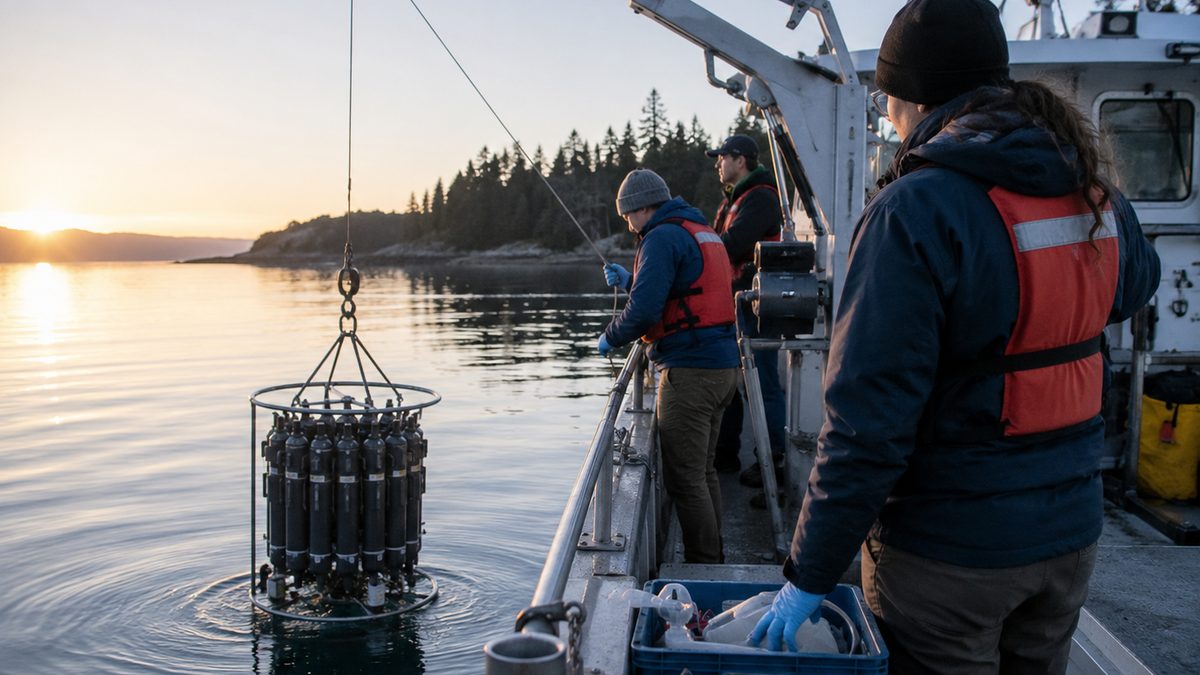
Ocean monitoring helps scientists measure chemical changes that can affect coastal ecosystems and fisheries. Editorial illustration by TheDailyGlobe.
Key Facts
- NOAA Research materials describe ocean acidification missions focused on tracking changing ocean chemistry.
- NOAA IOOS updates provide coastal ocean observing context for June 2026.
- Ocean acidification can affect shellfish, fisheries, reefs and coastal ecosystems.
- Ocean observations can help scientists measure changing conditions, but data alone does not solve the underlying problem.
- The available materials do not establish how every coastline, fishery or coastal business will be affected.
Ocean change can sound distant until it reaches a dinner plate, a fishing dock or a coastal business. Shellfish growers, fishing crews, reef communities and waterfront towns all depend on ocean conditions that can shift in ways most people never see from the shoreline.
That is why NOAA’s coastwide ocean acidification research missions matter. NOAA Research and NOAA IOOS materials describe work focused on measuring changes in ocean chemistry, including conditions tied to acidification. The goal is not simply to collect numbers. It is to understand how the ocean is changing in places where marine life and coastal economies depend on stable conditions.
Ocean acidification is often described as the ocean becoming more acidic, but the process is really about chemistry. As seawater chemistry changes, some marine organisms can have a harder time building or maintaining shells and skeletons. That makes the issue especially important for shellfish, fisheries, reefs and the communities that depend on them.
What Ocean Acidification Means
For readers, the simplest way to understand ocean acidification is this: seawater chemistry changes, and those changes can make life harder for organisms that rely on calcium carbonate to build shells or skeletons. That includes oysters, clams, some plankton and corals.
The issue does not always look dramatic. There may be no obvious sign from a beach or pier that chemistry is shifting offshore. But small changes in pH and related chemistry can matter to marine life, especially during sensitive growth stages.
That is one reason scientists measure ocean conditions directly. Without instruments, sampling and long-term observations, communities may not know whether local waters are changing, how fast the changes are happening or which areas are most exposed.
Why NOAA Is Measuring Coast to Coast
NOAA’s research missions are part of a practical science effort: measure the ocean carefully enough to understand what is changing. Coastwide observations can help scientists compare conditions across regions instead of relying on isolated snapshots.
That matters because the ocean does not change the same way everywhere. Coastal waters can be shaped by local currents, river runoff, upwelling, temperature, pollution, seasonal conditions and biological activity. A shellfish area in one region may face different chemistry than a reef area somewhere else.
A broader observing effort can help researchers identify patterns and give coastal communities better information. The measurements can help show where acidification is appearing, how conditions vary and what kinds of marine life may face greater stress.
How Ocean Observations Work
Ocean observing is not one thing. It can involve research vessels, sampling equipment, sensors, buoys, gliders and coastal monitoring networks. Scientists collect data on seawater chemistry and related conditions, then compare those readings over time and across places.
The work is careful and repetitive by design. One measurement may be useful, but repeated measurements are what help reveal trends. A single sample can show conditions at one time and place. A larger observing system can help scientists see whether a change is temporary, seasonal or part of a longer pattern.
That is where NOAA IOOS, the Integrated Ocean Observing System, matters. IOOS helps support coastal and ocean observing networks that gather data used by researchers, communities and decision-makers. In the context of acidification, those observations can help translate invisible chemistry into information people can use.
Why Coastal Communities Care
Ocean acidification is not only a laboratory issue. It can become a local economic issue when marine species that people harvest, sell or depend on are affected. Shellfish are one of the clearest examples because oysters, clams and similar species rely on shell-building chemistry.
Fisheries can also be affected indirectly. If acidification changes the base of the food web or stresses species that other marine animals depend on, the effects may move through ecosystems in ways that are not immediately obvious. Reefs can face their own risks because they depend on conditions that support calcium carbonate structures.
For coastal businesses, the concern is practical. A seafood business, marina, tourism operator, processor or restaurant may not track ocean chemistry every day. But those businesses can still be affected if fishery conditions shift, harvests become less predictable or local marine ecosystems weaken.
What the Data Does Not Solve
Better measurement is important, but it does not fix ocean acidification by itself. Data can show what is happening, where conditions are changing and which areas may need closer attention. It cannot, on its own, stop the chemical changes or determine how every community should respond.
The available information also does not show that every coastline will be affected in the same way. Some areas may be more sensitive than others. Some species may be more vulnerable. Local conditions can make a large difference.
That is why the scientific value is in careful observation, not sweeping claims. NOAA’s work can help build a clearer picture, but researchers still need time, repeated measurements and regional context to understand what the data means for specific ecosystems and economies.
What Comes Next
The next thing to watch is what NOAA’s missions and observing networks report as data is collected and analyzed. Future updates may show how conditions differ by coast, season and ecosystem type.
Readers should also watch for how coastal communities, fisheries and shellfish growers use the information. Good ocean data is most useful when it helps people understand real conditions where they live and work.
The clearest takeaway is that ocean acidification is not an abstract science term. It is a measurable change in ocean chemistry that can matter for marine life, seafood, coastal jobs and local economies. NOAA’s research missions are part of the work of seeing those changes clearly before they become harder to understand.
Reporting note: Reporting draws on NOAA Research materials, NOAA IOOS updates, ocean observation program information, and reviewed background materials. This article was produced with AI-assisted research and reviewed by an editor before publication.