New Porous Materials Could Store More Methane in Less Space
New materials-science research points to porous frameworks that may improve methane storage, but more testing is needed before practical use.
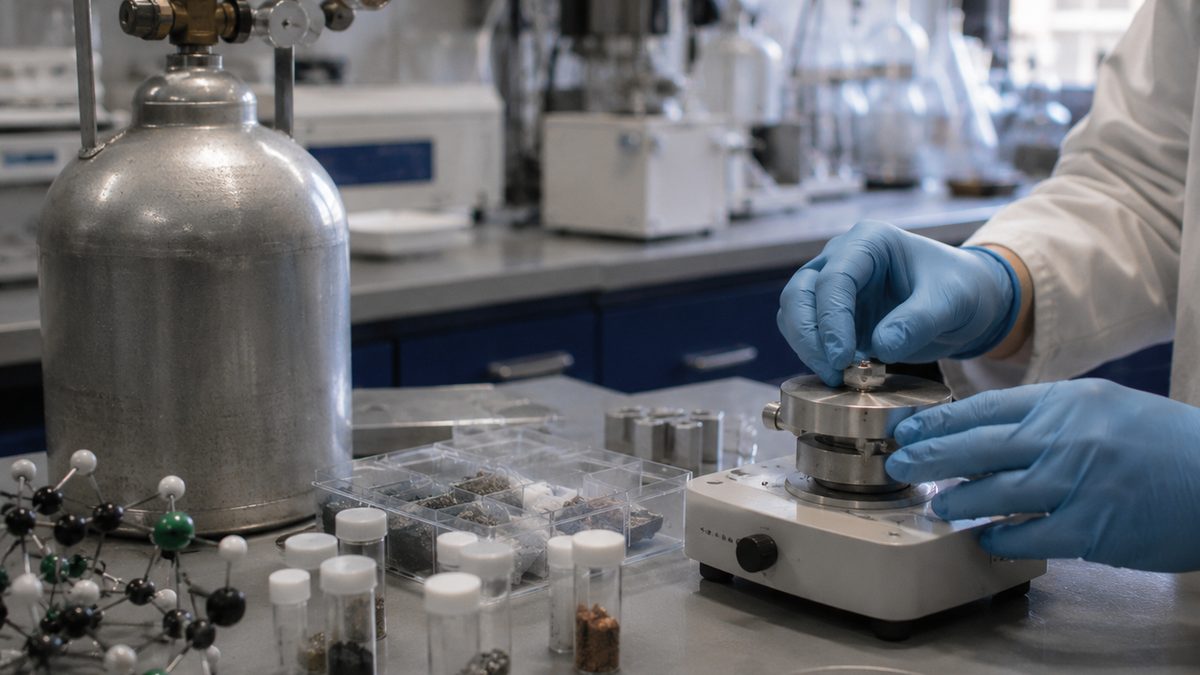
Porous materials research may help scientists study new ways to store methane more efficiently. Editorial illustration by TheDailyGlobe.
Key Facts
- Nature Materials reported research on metal-dipyrazolate frameworks with high methane-storage potential.
- Metal-organic frameworks are porous materials that can be designed to hold gases within internal structures.
- NIST background research has examined methane storage in metal-organic frameworks.
- The new research does not prove that the material is ready for commercial energy storage use.
- Further testing would be needed to understand performance, durability, cost, safety and real-world operating conditions.
Storing gas sounds simple until the goal is to fit more of it into less space, keep it stable and make the system practical outside a laboratory. That is one reason materials scientists keep studying tiny structures that can hold gases inside networks of pores.
New research reported in Nature Materials focuses on metal-dipyrazolate frameworks with high methane-storage potential. The work fits into a broader area of research on metal-organic frameworks, porous materials that can be designed to trap or hold certain gases.
For readers, the useful question is not whether this means a new energy product is around the corner. The better question is what these materials might improve, why methane storage is hard and what researchers still have to prove before a promising structure becomes useful in the real world.
What Porous Frameworks Are
A porous framework is a material built with tiny internal spaces. Those spaces can act like storage rooms at a molecular scale. Instead of gas floating freely in a large tank, molecules can interact with the inside surfaces of the material.
Metal-organic frameworks, often called MOFs, are one family of these materials. They are made from metal-containing parts connected by organic linkers. By changing the structure, researchers can tune the size, shape and chemistry of the pores.
That tunability is what makes the field interesting. Scientists are not only looking for a material that can hold gas. They are looking for materials that hold enough gas under useful conditions, release it when needed and remain stable over repeated use.
Why Methane Storage Is Difficult
Methane is the main component of natural gas. Storing it efficiently can be challenging because gases take up a lot of space unless they are compressed, cooled or held in a material that can pack more molecules into a smaller volume.
Compression can help, but it brings equipment, pressure and safety demands. Materials-based storage research asks whether specially designed solids can store methane more effectively under conditions that may be easier to manage.
The basic idea is not to make methane disappear into the material. It is to create internal surfaces where methane molecules can be held more densely than they would be in empty space. The better the material’s structure and chemistry, the more useful that storage may become.
What the New Material Appears to Improve
The Nature Materials research points to metal-dipyrazolate frameworks with strong methane-storage potential. In plain English, the material appears to offer a structure that can hold methane efficiently inside its pores.
That matters because small changes in framework design can make a large difference in gas storage. The size of the pores, the chemical environment inside them and the way the framework responds under pressure can all affect how much methane the material can hold.
Still, a promising lab result is not the same as a finished storage system. Materials science often moves through stages: discovery, measurement, comparison, stress testing, scale-up and only then possible practical use. This research belongs in that careful chain, not in an instant-breakthrough story.
What the Research Does Not Prove Yet
The available research basis does not show that the new framework is ready for commercial tanks, vehicles, pipelines or grid-scale use. It also does not prove that it can be manufactured cheaply, used safely at scale or maintain performance over long periods.
Those limits are important because energy research can be easy to overhype. A material can perform well in controlled tests and still face problems later. It may be difficult to make in large quantities. It may degrade. It may require conditions that are not practical. It may work scientifically but not economically.
The finding should therefore be read as a materials-science advance: a possible improvement in how methane can be stored inside porous frameworks. That is meaningful, but it is not the same as a deployed technology.
What Further Testing Would Need to Show
Further testing would need to answer several practical questions. Researchers would need to know how much methane the material stores under different pressures and temperatures, how quickly it can take up and release gas, and whether it keeps working after many cycles.
Durability would matter too. A storage material may face moisture, impurities, temperature changes and mechanical stress. A framework that looks strong in one test may behave differently under repeated real-world conditions.
Cost and manufacturing would also be central. A material that requires expensive ingredients or difficult production steps may be harder to use widely, even if the chemistry is impressive. Practical storage depends on the whole system, not only the best laboratory number.
Why This Kind of Research Matters
The value of this work is that it gives scientists more control over a hard storage problem. By studying how framework design changes methane uptake, researchers can learn which structures are worth testing further and which approaches may fall short.
That matters beyond one material. Porous frameworks are part of a larger effort to use chemistry to solve storage, separation and capture problems. Each well-measured result helps researchers understand how molecules behave inside carefully designed spaces.
The next thing to watch is whether follow-up studies confirm the material’s performance under broader conditions and whether researchers can show durability, manufacturability and safety outside controlled experiments. Until then, the clearest takeaway is measured: scientists may have found a better framework for methane storage, but the hard work of proving real-world usefulness is still ahead.
Reporting note: Reporting draws on Nature Materials research materials, NIST background research on methane storage in metal-organic frameworks, and reviewed scientific context. This article was produced with AI-assisted research and reviewed by an editor before publication.