How Tardigrades Survive Conditions That Would Kill Almost Anything Else
Tardigrades are famous for surviving extreme stress, but they are not indestructible. Their real trick is slowing life down when conditions turn brutal.
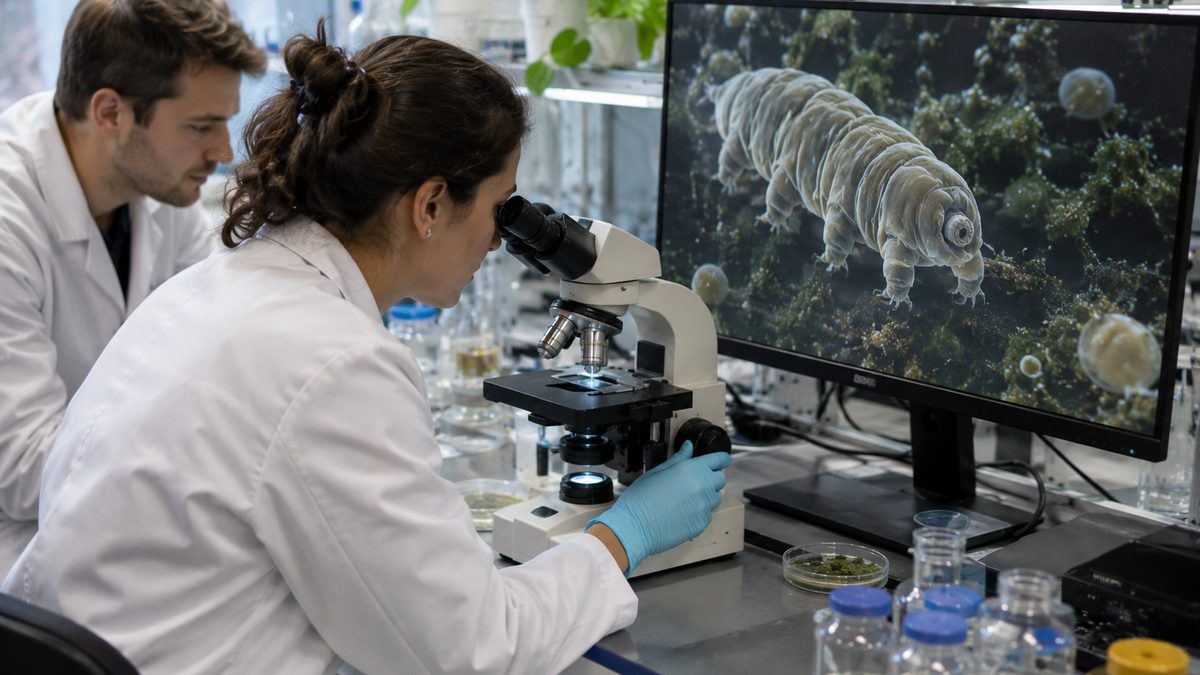
Tardigrades can survive extreme stress by entering a dormant state, but they are not indestructible. Editorial illustration by TheDailyGlobe.
Key Facts
- Tardigrades are microscopic animals known for surviving extreme environmental stress.
- They can enter a dormant state called a tun when conditions become harsh.
- In that state, normal activity slows dramatically, helping them survive drying, freezing, radiation and other stresses.
- NASA studies tardigrades in space to understand how their genes respond to extreme conditions.
- Tardigrades are not immortal or indestructible; survival depends on the severity and duration of the stress.
Tardigrades are often introduced like tiny superheroes: microscopic animals that can survive drying, freezing, radiation and even space-related stress. The nickname helps explain their internet fame, but it can also make the science sound like a magic trick.
The real story is more interesting. Tardigrades, sometimes called water bears, are not immortal or indestructible. They can die, and survival depends on the conditions and how long the stress lasts. What makes them remarkable is how they respond when the environment becomes too harsh for normal life.
Instead of simply powering through, tardigrades can shut down much of their normal activity and enter a dormant state. That biological pause helps explain why NASA studies them in space and why scientists see them as useful models for understanding stress, survival and resilience.
What Tardigrades Actually Are
Tardigrades are tiny animals, usually seen with a microscope, with rounded bodies and stubby legs that give them their water bear nickname. They live in many environments, including moss, soil, freshwater and marine settings.
Their fame comes from the mismatch between their size and their toughness. An animal barely visible to the naked eye can survive conditions that would destroy many larger creatures. That does not mean a tardigrade is always active under those conditions. Often, survival depends on doing almost the opposite of staying active.
The key is that tardigrades can change state. When their surroundings dry out or become otherwise dangerous, some species can pull in their legs, curl into a compact form and enter what scientists call a tun state.
The Power of Going Dormant
The tun state is central to tardigrade survival. In simple terms, the animal slows much of its normal life down. Its metabolism drops sharply, and the body becomes better able to tolerate stress that would normally be lethal.
This helps explain how tardigrades survive drying. Water is essential for ordinary biological activity. When water disappears, cells can be damaged, proteins can lose their shape and normal body systems can fail. Tardigrades have stress responses that help protect them while they wait for better conditions.
That waiting matters. The animal is not thriving in the way people usually use the word. It is enduring. When conditions improve, some tardigrades can rehydrate and resume activity. The difference between surviving and living normally is one of the most important parts of the story.
Why Space Researchers Care
NASA studies tardigrades because space is a stress test for biology. Microgravity, radiation and other conditions outside Earth can affect living systems in ways researchers want to understand better.
NASA's tardigrade research looks at how their genes respond to extreme stress. That does not mean scientists are trying to turn astronauts into tardigrades. It means these tiny animals may help researchers understand biological protection, repair and adaptation under conditions humans cannot safely experience in the same way.
The practical value is in learning from the mechanisms. If scientists can better understand how tardigrades protect cells and survive severe stress, that knowledge may inform broader research into health, space biology and how living organisms respond when normal conditions disappear.
Why the Indestructible Label Goes Too Far
Calling tardigrades indestructible is catchy, but it is not accurate. They can survive many extreme conditions, but not every condition, not forever and not always. Species differ, life stages differ and the length of exposure matters.
That distinction is important because it keeps the science from becoming a myth. Tardigrades are not proof that life can survive anything. They are evidence that some life has evolved unusual ways to pause, protect itself and recover when the environment becomes hostile.
Smithsonian coverage describes the search for explanations behind their hardiness, including how they manage stress at the cellular level. The exciting part is not that tardigrades break biology. It is that they show how flexible biology can be.
What the Science Still Does Not Prove
Tardigrade research does not prove that complex animals can easily survive space, that humans can copy tardigrade survival, or that these animals are untouched by harsh environments. It shows that certain small animals have biological tools that let them endure stress in ways scientists are still working to understand.
There is also a difference between surviving a laboratory test and surviving in a changing natural environment. In the wild, tardigrades face combinations of stress, competition and habitat conditions that do not always match controlled experiments.
The better way to see tardigrades is not as impossible creatures, but as reminders that life has more survival strategies than humans usually imagine. A tiny water bear can dry out, wait, recover and keep going. That is not immortality. It is a very small animal showing scientists something big about what life can do when the world turns hostile.
Reporting note: Reporting draws on NASA biological and physical sciences materials, Smithsonian science reporting, Smithsonian resilience materials, and reviewed biology context. This article was produced with AI-assisted research and reviewed by an editor before publication.