How Scientists Read the Air on Planets They Will Never Visit
Astronomers cannot travel to distant exoplanets, but they can still learn what some of those worlds' atmospheres are made of by studying tiny changes in starlight.
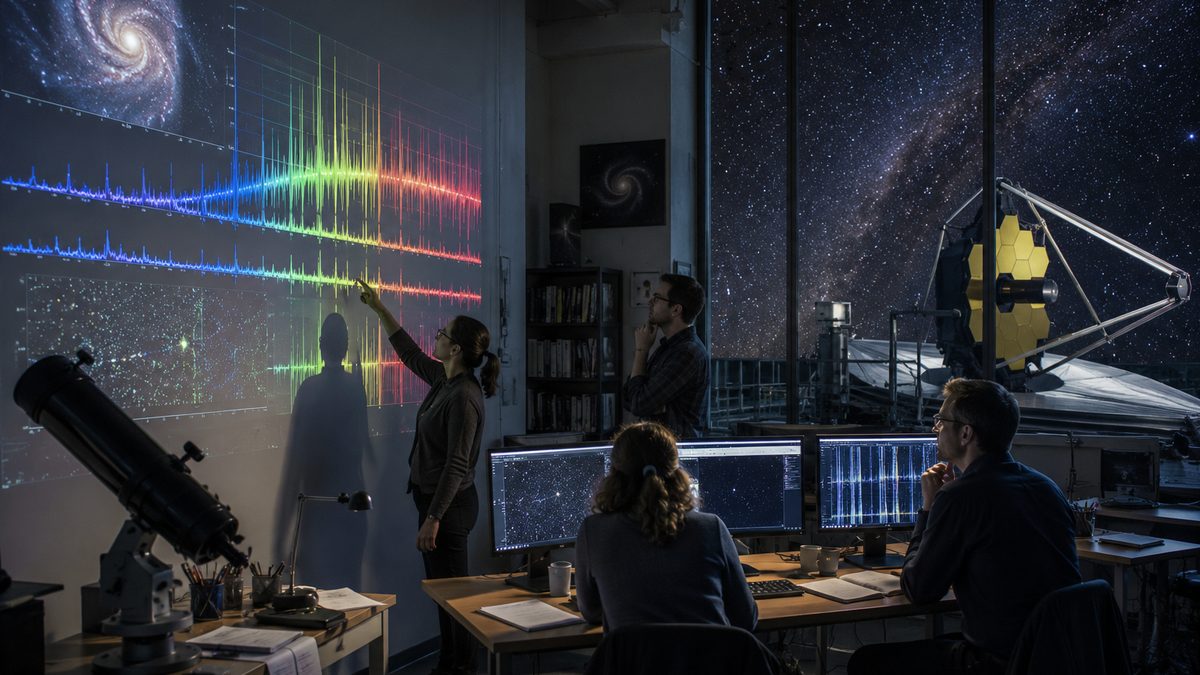
Astronomers use spectroscopy to identify gases in the atmospheres of distant planets by analyzing how starlight changes as it passes through them. Editorial illustration by TheDailyGlobe.
Key Facts
- Scientists use spectroscopy to study how light interacts with matter.
- When an exoplanet passes in front of its star, a small amount of starlight travels through the planet's atmosphere before reaching Earth.
- Different gases absorb specific wavelengths of light, creating unique patterns that scientists can identify.
- The James Webb Space Telescope observes many of these signals in infrared wavelengths that reveal molecules difficult to detect with visible light alone.
- Finding gases such as water vapor, methane, carbon dioxide, or oxygen does not by itself prove that life exists on another planet.
Imagine trying to figure out what the air smells like in a city thousands of light-years away without ever leaving Earth. That sounds impossible, yet astronomers routinely learn about the atmospheres of distant planets they cannot visit, photograph in detail, or sample directly. Their most powerful tool is not a spacecraft landing on another world. It is light.
Every Gas Leaves Its Own Fingerprint
Light may appear white to our eyes, but it contains a wide range of wavelengths. As light passes through a gas, certain wavelengths are absorbed while others continue on. The missing wavelengths form a distinctive pattern that scientists call a spectral signature. Because each chemical absorbs light differently, those patterns act much like fingerprints, allowing researchers to identify gases from enormous distances.
NASA describes spectroscopy as one of astronomy's most valuable scientific tools because it reveals information that cannot be seen in ordinary photographs. Instead of producing a detailed image of an exoplanet's surface, spectroscopy helps answer questions about what surrounds the planet.
How a Planet Helps Reveal Its Own Atmosphere
One common method is known as transit spectroscopy. When a planet passes between its star and Earth, most of the star's light is blocked by the planet itself. A tiny amount, however, filters through the planet's atmosphere before reaching telescopes. If gases are present, they remove specific wavelengths from that light. By comparing observations made before, during, and after the transit, scientists can detect those subtle differences.
The changes are extraordinarily small. Researchers often need repeated observations and careful analysis to separate a genuine atmospheric signal from background noise or instrumental effects. That is why major discoveries are typically confirmed over time rather than announced after a single observation.
Why the James Webb Space Telescope Matters
The James Webb Space Telescope was designed to observe much of the universe in infrared light. Many important molecules absorb infrared wavelengths, making that part of the spectrum especially valuable for studying planetary atmospheres. Webb has already expanded scientists' ability to detect compounds such as water vapor, carbon dioxide, methane, and other molecules on distant worlds.
Infrared observations also allow astronomers to study planets that are too faint or too distant for earlier telescopes to examine in similar detail. Rather than replacing previous observatories, Webb complements them by providing new information about the chemistry and structure of exoplanet atmospheres.
Why Atmospheric Gases Do Not Automatically Mean Life
Headlines about methane, oxygen, or water on distant planets often spark excitement about the possibility of alien life. Scientists are much more cautious. Many gases associated with life on Earth can also be produced through entirely natural geological or chemical processes. Detecting a molecule is only the beginning of the investigation, not the conclusion.
Researchers therefore study combinations of gases, the planet's temperature, the characteristics of its star, and many other environmental factors before considering whether biological activity is a plausible explanation. Even then, extraordinary claims require extensive evidence and independent confirmation.
Learning About Places Humans May Never Visit
The remarkable achievement of modern astronomy is not that scientists can photograph every distant world in detail. It is that careful measurements of starlight allow them to investigate planets that may remain physically unreachable for generations. Every new spectrum adds another piece to the growing picture of how planets form, evolve, and differ from one another.
As telescopes become more sensitive, astronomers expect to study increasingly smaller and more Earth-like planets. What those future observations will reveal remains uncertain, but the technique itself has already transformed the search for worlds beyond our solar system. By reading tiny missing slices of light, scientists can learn about places they may never set foot on, offering a clearer view of the diversity of planets across the galaxy.
Reporting note: Reporting draws on NASA Science materials covering spectroscopy, the James Webb Space Telescope, exoplanet research, and reviewed background information. This article was produced with AI-assisted research and reviewed by an editor before publication.