How Long Could a Human Survive on Mars Without a Spacesuit?
Mars may look familiar in photos, but its atmosphere, pressure, and temperature make it an environment where humans cannot survive without specialized life-support systems.
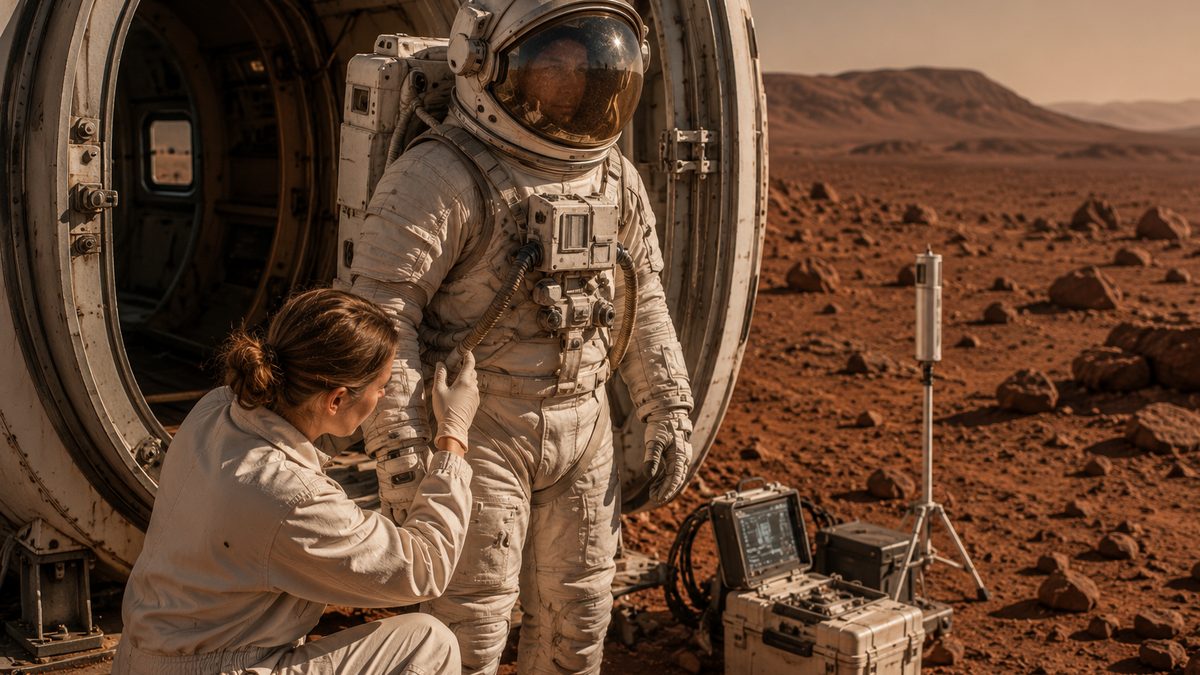
A spacesuit is a portable life-support system designed to protect astronauts from Mars' hostile environment. Editorial illustration by TheDailyGlobe.
Key Facts
- Mars has an extremely thin atmosphere made mostly of carbon dioxide.
- The planet's air pressure is far too low for an unprotected human to survive.
- A spacesuit provides pressure, breathable oxygen, temperature control, and other life-support functions.
- Holding your breath during sudden exposure to very low pressure can increase the risk of serious injury.
- NASA research shows that long-term survival on Mars requires protected habitats as well as spacesuits.
Many people have imagined what it would be like to step onto the surface of Mars. Movies often show astronauts walking across its dusty landscape, and photographs from robotic missions reveal mountains, valleys, and horizons that can seem surprisingly Earth-like. But appearances are misleading. Mars is one of the most hostile environments a human could enter, and surviving there depends on much more than simply having oxygen to breathe.
The Air Is Not Just Unbreathable
Mars' atmosphere contains very little oxygen and is composed primarily of carbon dioxide. Even if a person could somehow tolerate breathing carbon dioxide, there is another problem that is just as dangerous: there simply is not enough atmospheric pressure to support normal human life. Earth's atmosphere presses against our bodies every moment of every day. On Mars, that protective pressure is only a tiny fraction of what humans experience at sea level.
Pressure is so important because it helps keep the body's fluids functioning normally. Without adequate pressure, the human body cannot operate as it was designed. This is why astronauts cannot simply wear warm clothing and carry an oxygen tank. They need an environment that recreates the pressure their bodies require.
Why Holding Your Breath Would Be a Mistake
A common assumption is that someone suddenly exposed to Mars should hold their breath as long as possible. Space medicine research suggests the opposite. Holding your breath during rapid exposure to a very low-pressure environment can increase the risk of lung injury because expanding air inside the lungs has nowhere to escape. Astronaut training instead emphasizes allowing air to leave the lungs if pressure is lost unexpectedly.
NASA's research on the human body in space also shows that exposure to the space environment creates challenges far beyond breathing. Microgravity, radiation, isolation, and extreme environmental conditions all affect the human body during long-duration missions.
Cold Is Only Part of the Problem
Mars is well known for its cold temperatures, but freezing weather is only one hazard. The thin atmosphere provides little protection from harmful radiation and offers almost no insulation from dramatic temperature swings. Dust storms can cover enormous areas of the planet, yet even those storms occur in an atmosphere far thinner than Earth's.
Because the atmosphere is so thin, simply surviving outdoors is not a matter of wearing heavier clothing. Every excursion would require equipment capable of maintaining pressure, delivering oxygen, removing carbon dioxide, regulating temperature, and supplying electrical power for communications and other essential systems.
A Spacesuit Is Really a Personal Life-Support System
Modern spacesuits are often described as clothing, but that comparison misses their true purpose. They function as miniature spacecraft wrapped around the astronaut. They maintain internal pressure, circulate breathable air, remove excess carbon dioxide, regulate body temperature, and protect against the harsh environment outside.
Future Mars habitats would serve the same purpose on a larger scale. Living on Mars would require sealed, pressurized environments where people could breathe safely, work, sleep, and recover between excursions outside. Without those systems, the planet's atmosphere would make routine human activity impossible.
What Scientists Still Cannot Say Precisely
Researchers understand why Mars is incompatible with unprotected human life, but they do not describe survival as a simple countdown measured in seconds. Individual circumstances, environmental conditions, and the nature of any exposure all influence what happens. For that reason, NASA's public guidance focuses on explaining the hazards rather than assigning an exact survival time.
That distinction matters because it shifts the question away from dramatic speculation and toward engineering. The challenge of sending humans to Mars is not simply reaching the planet. It is building reliable life-support systems that can safely recreate the conditions the human body needs every moment astronauts are away from Earth. Until those systems exist, Mars remains a fascinating destination—but not a place where people can survive unprotected.
Reporting note: Reporting draws on NASA Glenn Research Center atmospheric data, NASA human spaceflight research, NASA Astrobiology materials, and reviewed background information. This article was produced with AI-assisted research and reviewed by an editor before publication.