Could Humans Ever Reach the Closest Star to Earth?
The nearest star beyond our Sun is closer than any other stellar destination, yet reaching it remains one of humanity's most difficult technological challenges.
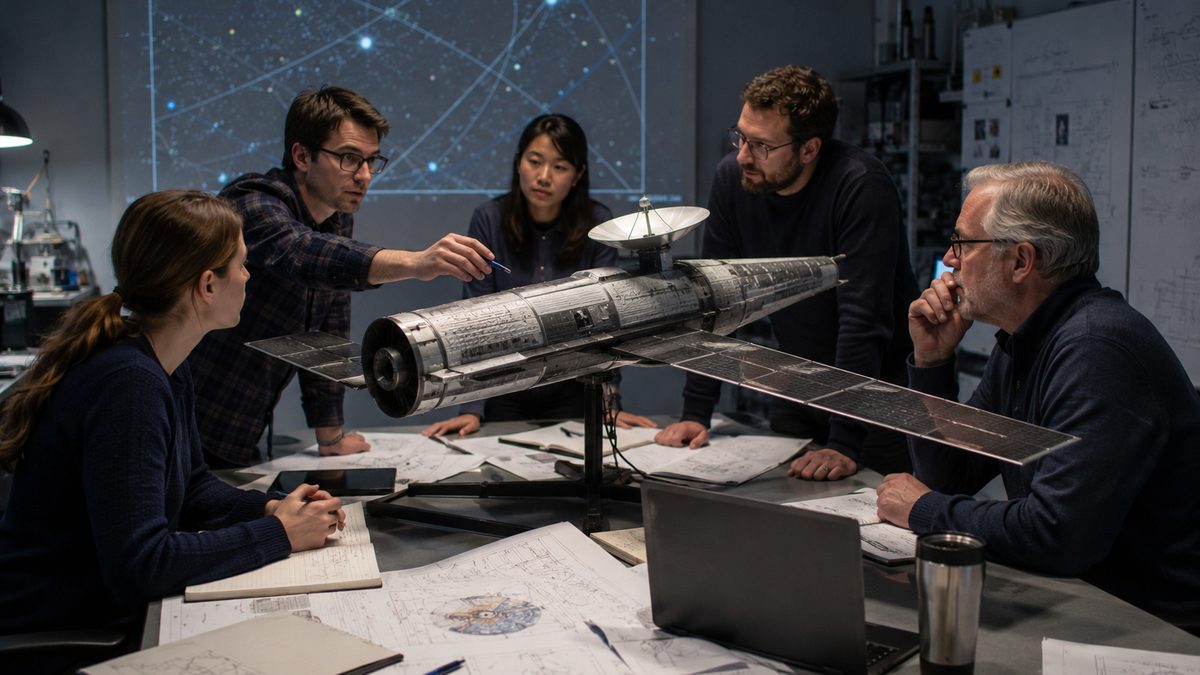
Scientists continue studying technologies that could one day make interstellar travel more practical than it is today. Editorial illustration by TheDailyGlobe.
Key Facts
- Proxima Centauri is the closest known star to Earth beyond the Sun.
- The star is about 4.2 light-years away.
- Current spacecraft technology would require thousands of years to reach it.
- Researchers are studying advanced propulsion concepts including nuclear systems and laser-driven sails.
- Keeping humans alive during an interstellar journey remains one of the largest obstacles.
Most people have looked up at the night sky and wondered what it would be like to visit another star. It sounds like a question from science fiction, but scientists have spent decades trying to understand whether such a journey could ever become reality.
The first destination would almost certainly be Proxima Centauri, the closest known star to Earth beyond our own Sun. Even so, 'closest' is a relative term in space. The distance is so vast that reaching it remains far beyond what current human spacecraft can accomplish.
How Far Away Is the Closest Star?
Proxima Centauri is located roughly 4.2 light-years from Earth. A light-year is the distance light travels in one year, nearly six trillion miles.
That means even our nearest stellar neighbor sits more than 25 trillion miles away. Numbers that large can be difficult to visualize. By comparison, the Moon is about 238,000 miles from Earth, and Mars is typically tens of millions of miles away depending on the planets' positions.
Space missions within our solar system already require enormous planning and resources. Traveling beyond the solar system presents an entirely different scale of challenge.
What Current Technology Could Do
Humanity has sent spacecraft beyond the planets and into interstellar space. NASA's Voyager probes, launched in 1977, continue traveling away from the Sun today.
The problem is speed. Although Voyager is moving remarkably fast by human standards, it is moving very slowly compared with the distance to another star. Estimates based on current spacecraft performance suggest that a journey to Proxima Centauri would take thousands of years.
In practical terms, no spacecraft technology currently used by humans can transport people to another star within a human lifetime.
The Search for Faster Propulsion
Scientists and engineers have proposed several ideas that could dramatically reduce travel times. One area of study involves advanced nuclear propulsion systems.
Unlike conventional chemical rockets, nuclear concepts could potentially provide greater efficiency and higher sustained speeds. Various designs have been explored over the years, though none have yet demonstrated the capability required for interstellar travel.
Another widely discussed concept is the use of powerful lasers to accelerate extremely lightweight spacecraft. The Breakthrough Starshot initiative has examined whether laser arrays on Earth could push small sail-equipped probes to a significant fraction of the speed of light.
The goal of such concepts is not to transport humans initially. Instead, researchers are exploring whether tiny robotic probes might someday reach nearby stars within decades rather than millennia.
The Human Problem Is Harder Than the Engineering Problem
Even if propulsion technology improves dramatically, transporting people introduces additional challenges. Humans need food, water, oxygen, medical care and protection from radiation.
Long-duration spaceflight already affects muscles, bones and other body systems. A mission lasting decades or generations would raise questions scientists have never had to answer before.
Researchers would also need to solve problems involving spacecraft reliability. Equipment failures that can be repaired from Earth today would become far more difficult to manage during a mission traveling trillions of miles from home.
Could Future Generations Make It Possible?
Scientists generally agree that interstellar travel is not impossible under the laws of physics as currently understood. The challenge is building technology capable of making such journeys practical.
What remains unclear is how quickly progress will occur. Researchers continue studying propulsion systems, materials, energy sources and long-duration spaceflight, but no existing program is close to launching a human mission to another star.
For now, Proxima Centauri remains a destination for future generations rather than current astronauts. Yet history offers a reminder that transportation technology can advance in ways previous generations never imagined. Crossing oceans once required months under sail. Reaching another star remains vastly harder, but scientists continue working on the same basic question: how can humanity travel farther than it ever has before?
Reporting note: Reporting draws on NASA materials, European Space Agency resources, Breakthrough Starshot research concepts, Harvard-Smithsonian Center for Astrophysics materials, and reviewed background materials. This article was produced with AI-assisted research and reviewed by an editor before publication.