Supreme Court Ends Term With Mixed Rulings on Presidential Powers
The Court expanded presidential control over some agencies, protected Fed Governor Lisa Cook for now, upheld late-arriving mail ballot laws, and left Trump’s E. Jean Carroll verdict in place.
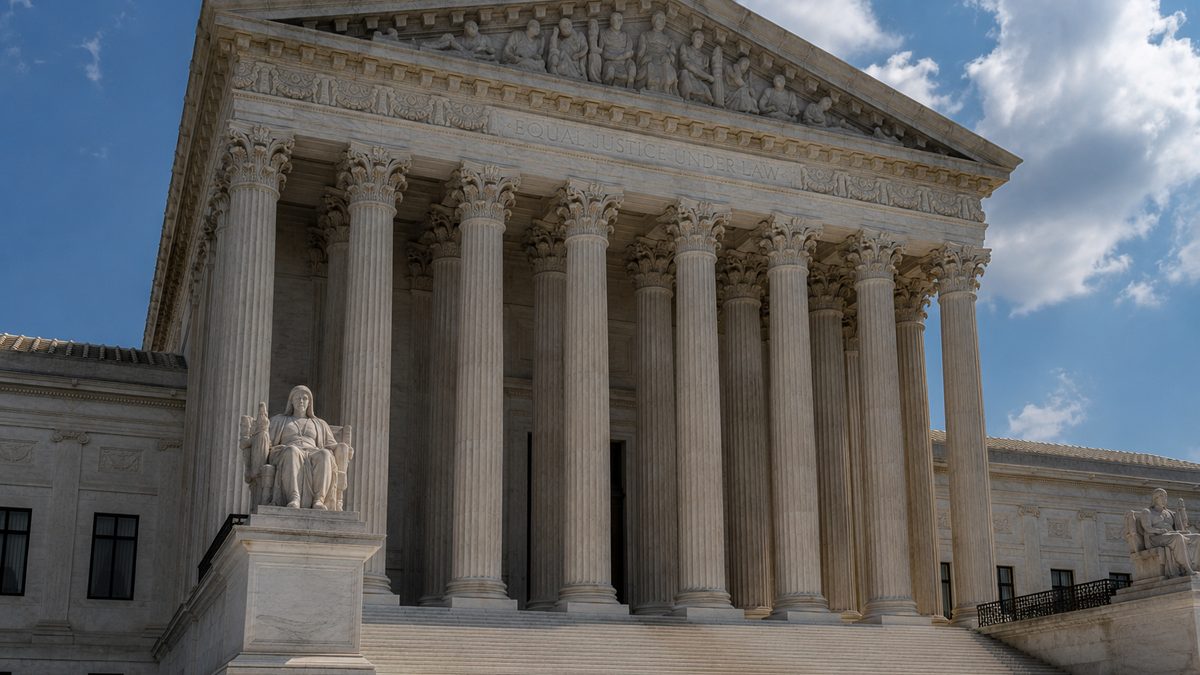
The Supreme Court closed its term with rulings touching presidential power, mail voting, Federal Reserve independence and Trump’s civil legal exposure. Editorial illustration by TheDailyGlobe.
Key Facts
- The Supreme Court allowed Federal Reserve Governor Lisa Cook to remain in her post for now while she challenges Trump’s effort to remove her.
- The Court also upheld Trump’s authority to remove certain independent agency officials, expanding presidential control over parts of the federal bureaucracy.
- The justices upheld state laws that allow mailed ballots to be counted after Election Day if they were postmarked by Election Day.
- The Court declined to hear Trump’s appeal of the $5 million E. Jean Carroll civil verdict, leaving the lower-court result in place.
- The Supreme Court’s public schedule listed June 29, 2026 as a day for an order list and possible opinions.
The Supreme Court ended its term Monday with a set of rulings that did not fit neatly into one political headline.
The justices gave President Donald Trump a major victory by strengthening presidential authority over parts of the federal bureaucracy. But they also kept Federal Reserve Governor Lisa Cook in her post for now, upheld state laws allowing some mailed ballots to arrive after Election Day, and declined to hear Trump’s appeal of the $5 million E. Jean Carroll civil verdict.
Together, the decisions offered a complicated final day: more power for the presidency in some agency-removal fights, a line around the Federal Reserve, protection for certain mail-ballot rules, and no Supreme Court relief for Trump in one civil case.
A Final-Day Test of Presidential Power
The biggest legal shift came in the Court’s ruling on independent agencies. For decades, some federal agencies have been designed to operate with a degree of insulation from direct White House control. Congress has sometimes limited when a president can remove agency officials, especially at bodies meant to regulate markets, labor, consumer protection, communications or other areas where continuity is valued.
The Court’s ruling strengthens the president’s hand in that fight. By upholding Trump’s authority to remove certain independent agency officials, the justices moved more power toward the White House and away from the older model of agency independence.
For readers, the practical question is not just who wins a legal argument inside Washington. It is how much control any president should have over officials whose agencies make rules that can affect workers, businesses, consumers and markets. The ruling gives presidents more room to demand control over parts of the executive branch, though its reach depends on the agency and the legal context.
That makes the decision important beyond the Trump administration. A stronger removal power can help presidents carry out their agenda more directly. It can also reduce the distance between regulatory agencies and short-term political pressure. The Court’s ruling puts that balance more firmly on the side of presidential control for the agencies covered by the decision.
Why the Federal Reserve Case Stands Apart
The Court did not treat the Federal Reserve the same way.
In a separate ruling, the justices allowed Fed Governor Lisa Cook to keep her job for now while she challenges Trump’s attempt to remove her. That does not settle every future question about presidential authority over the central bank. But it preserves Cook’s position while the legal challenge continues.
The Fed case matters because the central bank plays a direct role in decisions that affect interest rates, inflation, employment and financial markets. Its independence is built around the idea that monetary policy should not move simply because a president wants lower rates, faster growth, tighter credit or a more favorable political climate.
Cook’s case is also different from an ordinary personnel fight. Trump sought to remove her over disputed mortgage-fraud allegations, which Cook has denied. The Court’s decision keeps her in place during the challenge and signals that the Fed may receive different treatment from other independent bodies, at least in this posture.
That distinction is the key. The Court strengthened presidential control over some agency officials, but it did not give Trump immediate authority to remove a Federal Reserve governor. For households, borrowers and businesses, that matters because Fed decisions ripple into mortgage rates, credit-card costs, auto loans, savings returns and hiring conditions.
What the Mail-Ballot Ruling Means
The Court also rejected a challenge to state mail-ballot rules that allow ballots to be counted after Election Day if they were postmarked by Election Day.
The ruling was a loss for Republican challengers who argued that federal Election Day law barred states from counting ballots that arrived later. The Court upheld the state laws at issue, meaning states that allow the practice may continue to count those ballots under their own rules.
The decision does not create one national mail-voting rule. It does not mean every ballot arriving after Election Day must be counted everywhere. It means states with laws allowing late-arriving, timely postmarked ballots can keep those rules unless another legal change applies.
For voters, the safest takeaway is simple: state rules still matter. A ballot that counts in one state may not count under another state’s deadline. Voters should check their own state’s rules rather than assume that postmark rules are the same nationwide.
Carroll Verdict Left in Place
In another order, the Court declined to hear Trump’s appeal of the $5 million verdict won by writer E. Jean Carroll.
That order leaves the lower-court judgment in place. It is important to be precise about what happened: the Supreme Court did not issue a full merits ruling affirming the verdict. It declined review, which means the lower-court result remains intact.
The civil verdict found Trump liable for sexual abuse and defamation. It was not a criminal conviction, and it should not be described that way. The Supreme Court’s refusal to take the case means Trump did not get another chance at the high court to challenge that $5 million judgment.
The order adds another piece to a day already defined by mixed outcomes for Trump. He won a major executive-power ruling. He did not get immediate control over Cook’s Fed seat. Republican challengers lost on late-arriving mail ballots. And the Carroll verdict remained in place.
The Bigger Signal From the Court
The cleanest way to understand the Court’s final day is not as a simple pro-Trump or anti-Trump turn. The rulings moved in different directions depending on the legal question.
On independent agencies, the Court favored a stronger presidency. On the Federal Reserve, it preserved Cook’s position while her challenge continues. On mail ballots, it allowed states with postmark-based rules to keep counting certain ballots after Election Day. On the Carroll case, it left a civil judgment against Trump untouched by declining to hear his appeal.
That mix is why the day matters. The decisions touch how federal agencies answer to presidents, whether central-bank officials can be insulated from political pressure, how states administer mailed ballots, and how far Trump can continue one civil legal fight.
Several questions remain open. Cook’s challenge continues. The full practical reach of the agency-removal ruling will be tested in future disputes. State election laws will still vary. And the Court’s refusal to hear the Carroll appeal ends that path of review without a full Supreme Court opinion explaining the case.
The term closed with a stronger presidency in some places, limits in others, and a reminder that Supreme Court outcomes often resist the easiest political labels. The next fights will be over how lower courts, agencies, states and future presidents apply those lines.
Reporting note: Reporting draws on Associated Press coverage, Supreme Court public schedule and order information, Washington Post legal coverage, and contemporaneous reporting on the Court’s June 29, 2026 rulings and orders. This article was produced with AI-assisted research and reviewed by an editor before publication.