Who Gets Remembered? The Quiet Importance of Local Obituaries
Local obituaries do more than announce a death. They preserve ordinary lives, family histories, and the memory of a community.
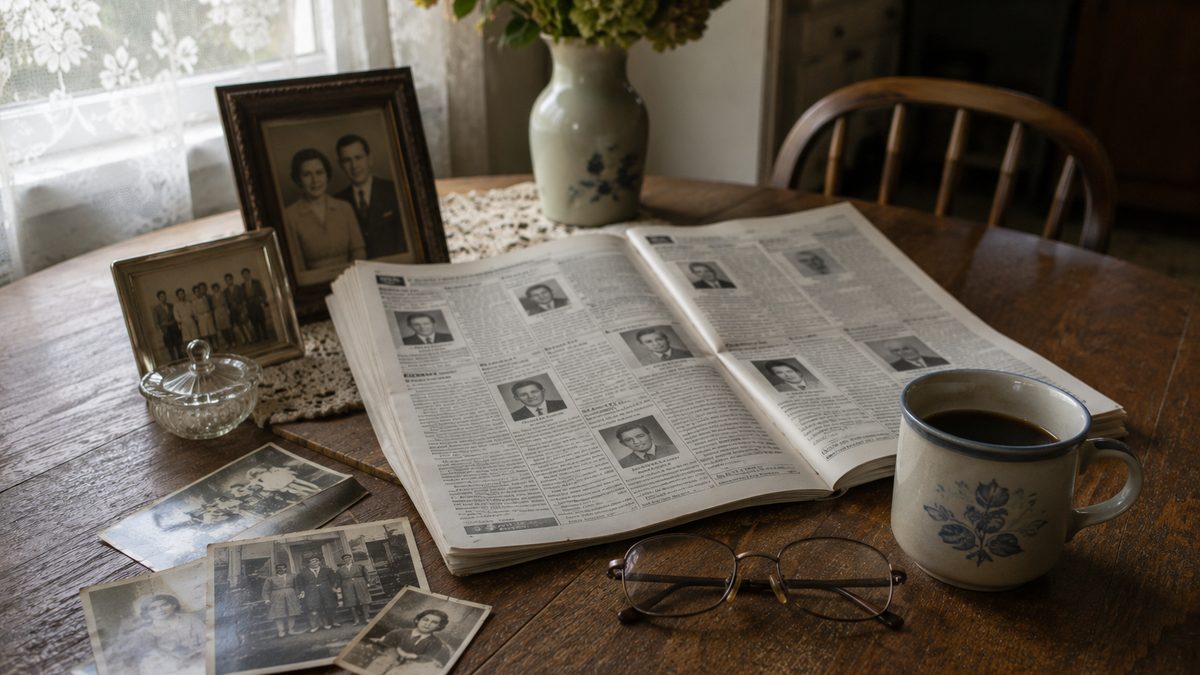
Local obituaries preserve family history and community memory in ways that often last for generations. Editorial illustration by TheDailyGlobe.
Key Facts
- Obituaries document community history as well as individual lives.
- Local newspapers have traditionally maintained obituary sections as a public record for families and communities.
- Obituaries often become important genealogical records for future generations.
- Funeral, journalism, and obituary resources continue to treat accuracy, clarity, and respect as central to obituary writing.
- Local obituaries can preserve details about ordinary lives that may not appear in any other public record.
A local obituary can look small on the page. A name, a few dates, a list of relatives, a service time, maybe a short account of work, military service, church life, hobbies, or favorite places. But for families and communities, those few paragraphs can carry more weight than almost anything else in the newspaper.
Obituaries are often the last public record of a person written for neighbors, relatives, friends, classmates, coworkers, and future generations. They tell a community that someone lived here, mattered here, worked here, raised children here, served here, built friendships here, and left a mark that deserves to be named.
That is why local obituaries remain one of journalism's most human traditions. They are not only about death. At their best, they are about memory, belonging, and the everyday history that rarely makes front-page news.
A Public Record of Ordinary Lives
Most people will never be the subject of a biography, documentary, museum exhibit, or national news story. Their lives are usually recorded in smaller ways: school photos, wedding announcements, military papers, work records, family albums, church bulletins, social media posts, and handwritten notes tucked away in drawers.
The obituary has long served as one of the few public forms that gathers those details into one place. It may mention where someone was born, who raised them, whom they loved, what work they did, what organizations they joined, what they enjoyed, and who survives them.
Those details may seem ordinary at the time. Years later, they can become the threads that help a family understand where it came from.
Why Local Newspapers Matter
Local newspapers have traditionally kept obituary sections because communities need shared records. A death notice tells neighbors when a service will be held. A fuller obituary gives friends and relatives a way to remember the person beyond the date of death.
In smaller communities, the obituary page can also show the shape of local life. It reflects teachers, factory workers, nurses, farmers, small business owners, veterans, coaches, volunteers, parents, grandparents, and neighbors whose contributions were often quiet but important.
That kind of record is difficult to replace. Social media posts can be immediate and heartfelt, but they are scattered. Family memories can be rich, but they are private unless someone writes them down. A local obituary gives a life a place in the shared memory of the community.
A Resource for Families Later
Obituaries often become useful long after the funeral is over. Genealogists and family members use them to trace relatives, confirm names, understand family connections, and learn where people lived, worked, worshiped, or served.
For younger generations, an obituary may be the first time they encounter the fuller story of a grandparent, great-aunt, uncle, neighbor, or family friend. It can answer questions that were never asked while the person was alive.
That is why accuracy matters. Names, relationships, dates, places, and service details are not small matters to the people who will rely on the record later. A careful obituary gives future readers a trustworthy starting point.
Writing With Respect Without Overstatement
A strong obituary does not need to make every person sound famous or perfect. In fact, the most meaningful remembrances are often specific rather than grand. They name the work someone did, the people they cared for, the routines they loved, the skills they shared, or the small habits relatives still remember.
That might mean noting that someone repaired every neighbor's lawn mower, never missed a school concert, kept a garden, coached Little League, made Sunday dinner, served on a local board, or remembered every birthday. These details help readers see a life clearly.
The challenge is balance. Obituaries should be respectful without becoming exaggerated, warm without becoming overly sentimental, and clear without reducing a life to a checklist.
What Families Can Preserve
Families who want to protect these records can keep printed copies, save digital versions, and store funeral programs or memorial materials with family papers. It can also help to write down stories that did not fit into the obituary but still matter.
Photos, recipes, letters, military documents, work badges, newspaper clippings, and handwritten notes can add context to the public record. Together, those pieces help keep a person's story from fading into a name and a date.
What remains uncertain is how local obituary traditions will continue changing as newspapers shrink, more notices move online, and families rely on digital platforms to share news. But the need behind the obituary has not disappeared.
Communities still need ways to say that ordinary lives are worth remembering. Families still need records that future generations can find. And journalism, at its most human, still has a role in helping people see that a community is made not only by major events, but by the lives of the people who lived there.
Reporting note: Reporting draws on National Funeral Directors Association resources, Society of Professional Journalists guidance, Legacy.com editorial resources, and reviewed background materials. This article was produced with AI-assisted research and reviewed by an editor before publication.