Walking School Buses Are Bringing Back a Simple Neighborhood Habit
Walking school buses give families a practical way to share school-morning routines, build neighborhood trust and help children walk together safely.
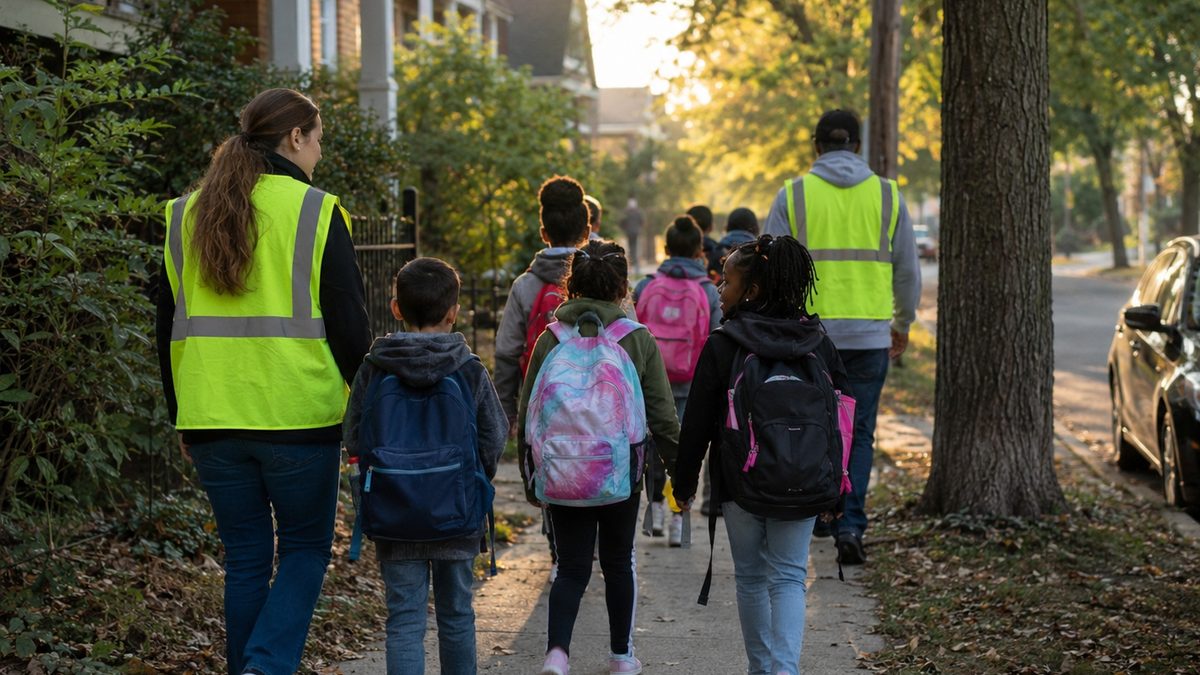
Walking school buses turn the trip to school into a shared neighborhood routine. Editorial illustration by TheDailyGlobe.
Key Facts
- NHTSA describes walking school buses as groups of students walking to and from school with volunteer adults on fixed routes and schedules.
- Safe Routes Partnership works on Safe Routes to School, Safe Routes to Parks and Safe Routes to Libraries.
- The Walking School Bus Guide is designed for parents, teachers, public health educators, law enforcement officers and others interested in safer walking and biking to school.
- It remains unclear how many U.S. schools currently operate active walking school bus programs.
- Sidewalks, school distance, traffic, weather and volunteer availability can affect whether the model works in a community.
On a busy school morning, the usual picture is a line of cars, parents watching the clock and children piling out near the curb. A walking school bus starts with a different scene: families meeting at a corner, backpacks on, adults checking the group and children walking together along a planned route.
The idea is simple enough that it almost sounds old-fashioned. A walking school bus is a group of students walking to or from school with volunteer adults, usually on a fixed route and schedule. It is not a new technology or a complicated program. It is a shared routine built around trust, timing and a few adults willing to walk.
A Shared Route Instead of Separate Mornings
A walking school bus works much like a regular bus route, except the bus is a group of children and adults on foot. Families may agree on a route, meeting points and timing. Children join along the way. Adult volunteers walk with the group, help supervise crossings and keep the morning moving.
For parents and grandparents, the appeal is easy to understand. One adult may not be able to walk every morning. Several adults sharing the job may make it possible. A child who might not walk alone may be able to walk with friends and trusted adults. A family trying to avoid a long car line may have another option.
That ordinary usefulness is what makes the idea stick. It does not ask families to remake their lives. It takes something many communities used to do informally and gives it enough structure to work in modern school routines.
Why It Feels Bigger Than a Walk
A walking school bus is partly about transportation, but it also touches something deeper: whether neighbors know each other well enough to share responsibility. A route only works if adults communicate, show up and trust one another with a basic part of the day.
That can matter in neighborhoods where families live close together but rarely interact beyond a wave from the driveway. A repeated morning routine gives people a reason to learn names, notice patterns and check in. The relationship does not have to be dramatic. It may be as simple as knowing which child joins at which corner and which adult walks on Fridays.
For children, the routine can also make the trip to school feel more connected to the neighborhood around them. Instead of moving from house to car to classroom, they walk past homes, sidewalks, crossing points and familiar faces. That can turn a school commute into a small lesson in place and community.
Safety Still Depends on the Street
The safety benefits of walking school buses should be described carefully. An organized group with adult volunteers can help children follow a route, cross at planned locations and stay together. But the model does not erase the conditions around it.
Some neighborhoods have sidewalks, short school distances, slower streets and safe crossings. Others have missing sidewalks, wide roads, heavy traffic, long distances or weather that makes walking difficult. A walking school bus may be practical in one community and much harder in another.
That is why the Walking School Bus Guide is aimed at a broad group of people, including parents, teachers, public health educators, law enforcement officers and others interested in safer walking and biking to school. The details matter. A route that works for children has to account for traffic, visibility, timing, supervision and the specific layout of the neighborhood.
The Family Logistics Matter Too
School mornings can be a pressure point for families. Work schedules, younger siblings, car access, bus timing and child care can turn a short trip into a daily puzzle. A walking school bus can ease some of that pressure when enough adults are available and the route is realistic.
It can also reduce some car trips near school, though the effect will vary by neighborhood and participation. For a family that lives close enough to walk but does not want a child walking alone, the group model can make walking feel more possible. For a family farther away, it may not solve the problem at all.
That distinction is important. Walking school buses are not a universal fix for school transportation. They are one practical tool for places where distance, sidewalks, traffic conditions and volunteer support line up well enough to make them work.
Trust, One Block at a Time
The most interesting part of the walking school bus may be how modest it is. It does not promise to solve every school-morning problem. It does not replace buses, cars or broader safety planning. It simply asks whether a few families on the same route can make the morning easier together.
What remains unclear is how many schools currently have active walking school bus programs and how participation varies across different communities. Neighborhood design, weather, school distance and volunteer availability can all shape whether the habit takes root.
Still, the model points toward something many families recognize immediately. Communities are built not only through big projects, but through repeated small routines. A walking school bus is just children and adults moving down the sidewalk together. In a busy, isolated age, that may be exactly why it feels worth noticing.
Reporting note: Reporting draws on Safe Routes Partnership materials, the Walking School Bus Guide, National Highway Traffic Safety Administration safety materials, and reviewed background materials. This article was produced with AI-assisted research and reviewed by an editor before publication.