Phone-Free Spaces Are Becoming a Real-World Response to Screen Fatigue
Restaurants, events and gathering spaces are testing phone-free rules as people look for more attention, conversation and relief from constant screens.
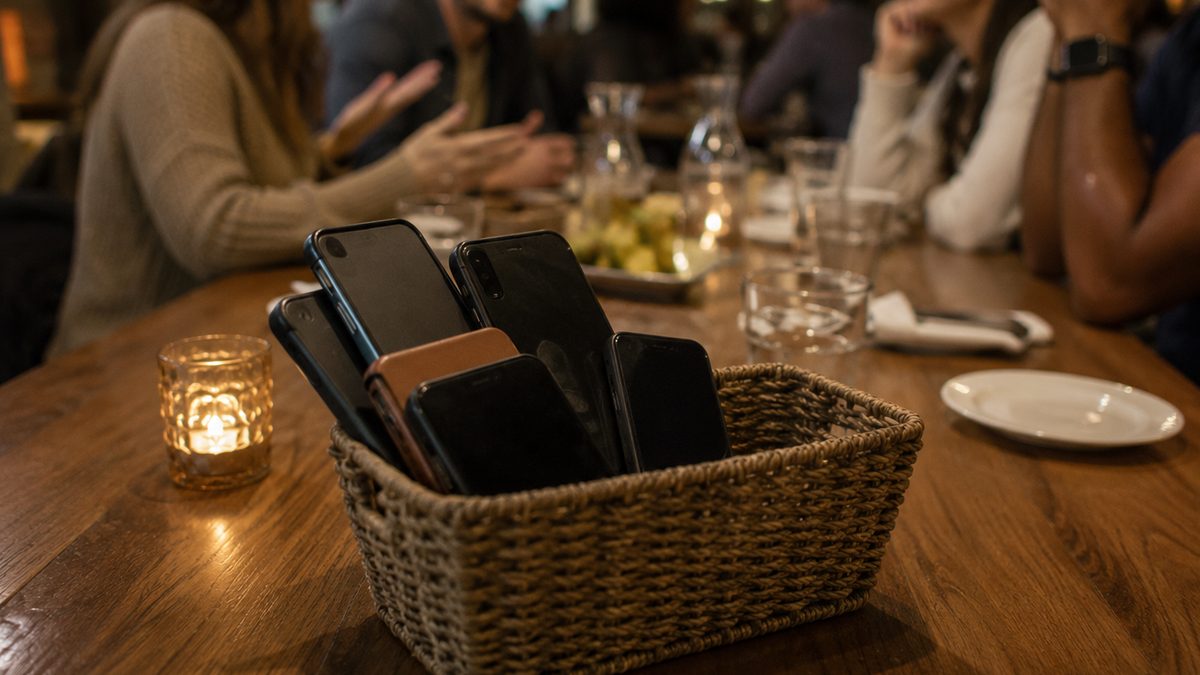
Phone-free spaces are emerging as one way people try to make room for attention and conversation. Editorial illustration by TheDailyGlobe.
Key Facts
- Axios has reported on phone-free restaurants, bars, events and digital detox spaces in 2026.
- Pew Research Center reports high smartphone and internet adoption in the United States.
- Pew’s 2025 social media report found many Americans use major platforms daily.
- Phone-free rules are appearing across different settings, including entertainment, schools and private events.
- It remains unclear whether phone-free spaces will become mainstream or remain a smaller niche.
At some dinners now, the first thing on the table is not the menu. It is a small basket where phones go face down, out of reach, while people try to talk without checking every buzz, alert or half-remembered message.
That small gesture says a lot about where digital life has landed. Phones are useful, necessary and woven into work, parenting, safety, directions, payments and daily plans. They are also often the thing pulling people away from the room they are already in.
Axios has reported on phone-free restaurants, bars, events and digital detox spaces in 2026. Pew Research Center reports high smartphone and internet adoption in the United States, and its 2025 social media report found many Americans use major platforms daily. Together, those facts help explain why phone-free spaces are getting attention: people are not giving up phones, but some are looking for places where phones are not the center of the experience.
Why Phone-Free Spaces Are Getting Attention
The appeal is not hard to understand. Many people spend the day moving between work messages, social feeds, group chats, school updates, delivery notifications, bank alerts and news. Even when a phone is not being used, it can still sit on the table as a quiet interruption waiting to happen.
Phone-free spaces try to change the default. A restaurant may ask guests to put phones away. A concert may use pouches or rules that limit recording. A retreat may make disconnection part of the event. A wedding or private gathering may ask guests to be present instead of filming everything.
The point is usually not to punish people for using technology. It is to create a different kind of room. If everyone knows the same rule applies, putting the phone away can feel less awkward. The shared agreement matters.
What People Are Trying to Protect
At the center of the idea is attention. A dinner feels different when people are not half-reading messages. A concert feels different when the crowd is not mostly looking through screens. A classroom feels different when students are not constantly managing notifications.
Conversation is part of it, too. Phones make it easy to avoid pauses, check out of uncomfortable moments or turn every gathering into a side conversation with someone who is not there. For some people, phone-free settings offer relief from the pressure to respond, record or post.
There is also a cultural piece. Social life has become more documented. Meals, vacations, shows, parties and school events can quickly become content. Phone-free spaces push back on that habit by saying the experience does not have to be captured to count.
Why This Is Not an Anti-Phone Story
A balanced view has to start with the obvious: phones are not just distractions. They are tools people use for real responsibilities. Parents may need to be reachable. Workers may be on call. People with health concerns may rely on devices. Some use phones for accessibility, translation, navigation, rides, payments or emergency contact.
That means phone-free rules can be helpful in one setting and unreasonable in another. A voluntary dinner rule among friends is different from a strict venue policy. A concert pouch system is different from a classroom rule. A retreat built around disconnection is different from a restaurant that surprises customers after they arrive.
The best versions of phone-free policies usually need room for exceptions. Safety, disability access, caregiving and work obligations are not minor details. If a rule ignores those needs, it can turn a good idea into a frustrating one.
The Pushback Is Practical
Some customers may simply not want restrictions. Others may worry about emergencies. Parents may not feel comfortable putting a phone away during a night out. People meeting someone new may want a phone nearby for safety. A worker waiting on a call may not be able to fully disconnect.
There are also logistics. Many restaurants and events now use phones for reservations, tickets, menus, payments, rideshares and parking. Asking people to put phones away sounds simple until the same business also depends on phones to manage the visit.
That tension is why phone-free spaces may not become universal. The idea works best where the rule clearly matches the purpose of the space: a performance where recording distracts, a retreat built around rest, a school trying to keep students focused, or a restaurant that wants conversation to be part of its identity.
What It Says About Digital Culture
The rise of phone-free experiments does not mean people are abandoning digital life. Pew’s research points in the opposite direction: smartphones, the internet and social platforms remain deeply embedded in American life.
What may be changing is the desire for boundaries. People can value their phones and still want breaks from them. They can use social media every day and still want a few hours where the group chat, camera roll and notifications are not running the room.
That is why the most useful way to see phone-free spaces is not as a backlash against technology, but as an attempt to make offline life feel more deliberate. The question is not whether phones are good or bad. It is when they help, when they interrupt and who gets to decide the rules of a shared space.
What to Watch Next
The next test is how people respond when rules move from novelty to expectation. A phone basket at a friend’s dinner may feel charming. A strict rule at a business may feel different, especially if customers are not warned ahead of time or if exceptions are handled poorly.
It also remains unclear whether phone-free spaces will become mainstream or stay limited to certain restaurants, events, schools and retreats. Customer response will matter. So will enforcement, accessibility, safety and whether the experience actually feels better.
For now, phone-free spaces are a sign that people are still negotiating digital life in public. The phone is not leaving the room forever. But in more places, people are asking whether it has to sit in the middle of the table.
Reporting note: Reporting draws on Axios coverage of phone-free restaurants, bars, events and digital detox spaces, Pew Research Center internet and smartphone adoption data, Pew social media use research, and reviewed background context. This article was produced with AI-assisted research and reviewed by an editor before publication.