Community Theater Is Still One of America’s Most Local Art Forms
Local theater connects volunteers, performers, schools, small businesses and audiences in a way that keeps the arts close to everyday community life.
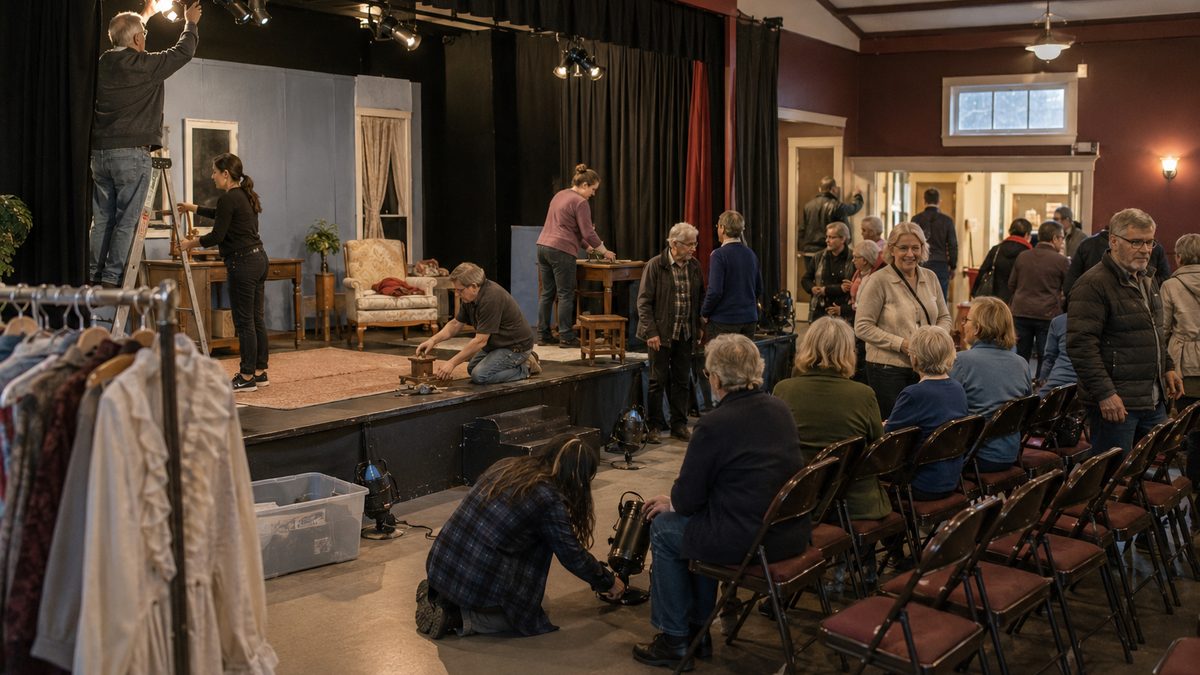
Community theater remains one of the clearest ways local arts connect performers, volunteers, audiences, schools and neighborhoods. Editorial illustration by TheDailyGlobe.
Key Facts
- Community theater relies heavily on local performers, volunteers, audiences, donors and organizers.
- American Association of Community Theatre survey materials provide a window into current community theater operations and trends.
- Theatre Communications Group tracks broader nonprofit theater research through its Theatre Facts work.
- Americans for the Arts research connects nonprofit arts and culture activity to local economic and civic life.
- Not every community theater is financially stable, and local groups can face pressure from costs, staffing, volunteers and audience habits.
A community theater performance usually starts long before the curtain rises. Someone paints a flat. Someone finds a missing costume piece. Someone sells tickets at a folding table. A teacher brings students. A nearby restaurant gets a little more dinner traffic before showtime.
That is what makes community theater different from many other parts of American culture. It is not only a show on a stage. It is a local system of volunteers, performers, audiences, schools, small businesses and civic pride working in the same room.
Research from the American Association of Community Theatre, Theatre Communications Group and Americans for the Arts points to the continuing role of local arts organizations in civic and economic life. The numbers and surveys matter, but the story is simple: community theater remains one of the most local ways Americans make and experience art together.
Why Community Theater Feels Different
Community theater is often built by people who live near the audience. The actor onstage may be a teacher, nurse, mechanic, student, retiree or parent from the same town. The person running lights may also help build sets. The ticket taker may have been in last season’s musical.
That closeness changes the experience. Audiences are not only watching professionals from far away. They are seeing neighbors try something difficult in public. That can make the performance feel less polished than a large commercial production, but also more personal.
The local nature of the work is part of the value. A community theater gives people a place to gather around a story, a comedy, a musical, a children’s production or a familiar holiday show. It makes culture feel less distant and less expensive to enter.
The Volunteer Engine Behind the Stage
Community theater depends on work most audiences never see. Sets need to be built. Costumes need to be stored, altered and found. Programs need to be printed. Auditions need to be organized. Rehearsal spaces need to be scheduled. Someone has to answer emails, clean the lobby and fix whatever breaks before opening night.
Much of that labor is done by volunteers or part-time staff. That can keep productions possible, but it can also make organizations fragile. When the same small group of people carries too much of the work, burnout becomes a real concern.
That is why community theater is both charming and hard. It can look casual from the outside, but behind the scenes it often requires the same habits any serious local institution needs: planning, money, leadership, trust and people willing to keep showing up.
How Local Theaters Connect a Town
A community theater can touch more people than the cast list suggests. Schools may use it as a first stage for young performers. Parents may volunteer backstage. Retirees may find a place to stay active. Local businesses may advertise in programs, sponsor productions or benefit from foot traffic on performance nights.
Those connections are part of why local arts matter beyond entertainment. Americans for the Arts’ economic research focuses on the broader role nonprofit arts and culture organizations can play in local communities. Community theater fits that pattern in a practical way: a performance can bring people into a downtown, fill seats, support nearby restaurants and give residents a reason to spend time together.
The civic value may be even clearer than the economic value. A theater gives a town shared memories. People remember the high school student who stunned the room, the neighbor who made everyone laugh, the production that brought families out on a cold weekend, or the volunteer who kept the place running for decades.
Why It Is Not Always Stable
It would be wrong to describe community theater as easy or automatically secure. Local theaters can struggle with rising costs, aging buildings, inconsistent ticket sales, changing audience habits, volunteer shortages and competition for people’s time.
Some groups have strong donor bases and full houses. Others operate close to the edge. A small drop in attendance, a repair bill, a lost rehearsal space or a few key volunteers stepping away can create real problems.
That uncertainty matters because community theater often works best when it feels permanent. Audiences come to expect the annual musical, the summer youth program or the holiday performance. But keeping those traditions alive requires money, organization and a steady supply of people willing to do unglamorous work.
What Keeps It Alive
The strongest case for community theater is not that it competes with Broadway or big-city arts institutions. It does not need that comparison. Its value is closer to home.
Community theater gives people a place to participate, not just consume. It lets a teenager try acting, a carpenter build a set, a retiree return to the stage, a musician join the pit, a parent volunteer in the lobby and an audience see something made by people they may know.
That makes it one of America’s most local art forms. It survives because people want more than entertainment from a screen. They want a room, a stage, a story and the small civic magic of watching neighbors make something together.
Reporting note: Reporting draws on community theater research, nonprofit arts data, cultural organization materials, and reviewed background materials. This article was produced with AI-assisted research and reviewed by an editor before publication.