Community Fridges Turn Food Sharing Into Neighborhood Culture
Community fridges give neighborhoods a simple way to share food, reduce waste and build local trust, while still depending on careful upkeep and safety rules.
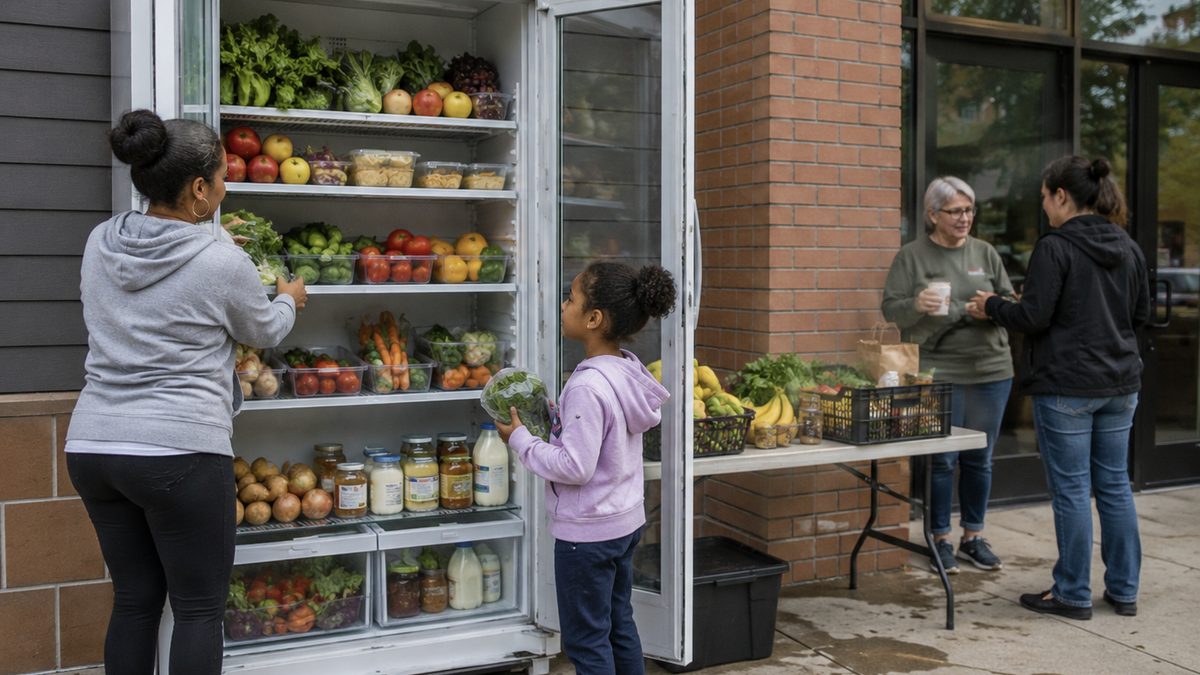
Community fridges turn food sharing into a visible neighborhood habit. Editorial illustration by TheDailyGlobe.
Key Facts
- Community fridges are public refrigerators where people can share food at the neighborhood level.
- Freedge describes community fridges as tools for reducing food insecurity, reducing food waste and building community.
- Associated Press reporting has documented community fridge networks and other neighborhood sharing efforts in U.S. communities.
- Harvard Law School Food Law and Policy Clinic has described community fridges as a way to reduce food waste as well as help with hunger.
- It remains unclear how many community fridges currently operate nationwide, and local health rules and maintenance practices vary by city.
A community fridge is easy to understand because it looks ordinary. It may sit outside a neighborhood center, on a sidewalk, near a church, beside a small business or on a porch where people already pass by. Inside might be vegetables, prepared food, milk, bread or pantry items. The idea is plain: take what you need, leave what you can.
That simplicity is part of why community fridges have become more than a food access tool. They are also a visible sign of neighborhood culture, where food sharing happens in public and people do not have to wait for a formal program, appointment or application to help or be helped.
Associated Press reporting has documented community fridge networks and other neighborhood sharing efforts in U.S. communities. Freedge, a community fridge organization, describes the model as a way to reduce food insecurity, cut food waste and build community. Harvard Law School’s Food Law and Policy Clinic has also connected community fridges to food-waste reduction and climate-related benefits.
How a Community Fridge Works
The basic model is not complicated. A refrigerator is placed in a public or semi-public location. Volunteers, neighbors, local businesses or community groups help stock it. People who need food can take items. People who have extra food can leave items, depending on the fridge’s rules.
Some fridges are paired with shelves for dry goods. Others have small tables, donation bins or posted guidelines. The best-run versions usually depend on regular cleaning, clear food-safety expectations and people who check the fridge often enough to remove spoiled items.
That last part matters. A community fridge is not magic. It works only when people maintain it. A well-stocked, clean fridge can feel like a small neighborhood safety net. A neglected one can quickly create food-safety concerns or lose public trust.
Why the Idea Connects Right Now
Food costs have made grocery shopping more stressful for many households. Even families who are not in crisis may notice that a routine shopping trip costs more than it used to. For people already living close to the edge, a bag of produce or a few ready-to-eat items can matter.
Community fridges meet that pressure in a direct way. They do not require a person to prove need at a counter. They do not require a long process. They let food move quickly from someone who has it to someone who can use it.
That does not mean community fridges solve food insecurity by themselves. They are too small, uneven and locally dependent for that. But they can help in the spaces between larger systems: after work, between paychecks, when a pantry is closed, when a family has extra groceries, or when a restaurant or neighbor has food that would otherwise go to waste.
Food Waste Is Part of the Story
The food-waste side is important because many communities have both need and excess at the same time. Food can be thrown out because it is near a sell-by date, because a garden produced too much, because an event had leftovers or because a household bought more than it could use.
Community fridges offer one practical way to redirect some of that food. The Harvard Law School Food Law and Policy Clinic has described community fridges as not only hunger-fighting tools but also part of the food-waste and climate conversation.
The environmental argument is straightforward: edible food that is shared does not become trash as quickly. Still, the safety and quality of the food matters. Not every leftover belongs in a public fridge, and local rules may limit what can be donated.
Trust Is the Hidden Ingredient
A community fridge depends on something harder to measure than pounds of food or number of visits. It depends on trust. People have to trust that the food is safe enough to take. Donors have to trust that contributions will be used respectfully. Neighbors have to trust that the fridge will not become neglected, messy or burdensome.
That is why the culture around the fridge matters. A refrigerator alone is just an appliance. A working community fridge becomes a habit: someone wipes it down, someone drops off fruit, someone removes expired items, someone tells a neighbor it is there.
At its best, the model avoids turning need into spectacle. People can use the fridge without being turned into a story. The exchange is public, but it does not have to be performative. That dignity is part of what makes the idea appealing.
The Practical Limits
Community fridges also come with real limits. The handoff is informal, but food safety is not. Different cities may have different health rules, and organizers may have to think about refrigeration, cleaning, liability, labeling, prepared foods and who is responsible when something goes wrong.
Maintenance can also be difficult. A fridge needs electricity, a safe location, regular checks and volunteers who do not disappear after the first burst of enthusiasm. It may also need cooperation from nearby businesses, property owners or neighborhood groups.
The available reporting does not establish how many active community fridges operate nationwide. It also does not show that every fridge is equally stocked, safe or well maintained. Those differences matter because the idea works best when local people treat the fridge as shared infrastructure, not a one-time project.
Why Small Food Sharing Still Matters
Community fridges are not a replacement for wages, benefits, food banks, school meals or broader public policy. They should not be asked to carry more weight than they can handle. But their value is not only in solving a problem at scale.
Their value is also cultural. They make food sharing visible. They remind people that a neighborhood can have practical habits of care. They turn extra groceries, garden produce and leftover abundance into something someone nearby might actually use.
The next thing to watch is how communities handle the less romantic parts: upkeep, safety, local rules and steady volunteer support. If those pieces hold, the humble refrigerator on the corner can become more than a place to leave food. It can become a small, everyday sign that people still know how to look out for one another.
Reporting note: Reporting draws on Associated Press reporting, Freedge community fridge materials, Harvard Law School Food Law and Policy Clinic analysis, and reviewed background materials. This article was produced with AI-assisted research and reviewed by an editor before publication.