Why America’s Everyday Hangout Spots Are Disappearing
Researchers and community organizations are paying closer attention to the informal gathering places that help people build friendships, trust, and a sense of belonging outside home and work.
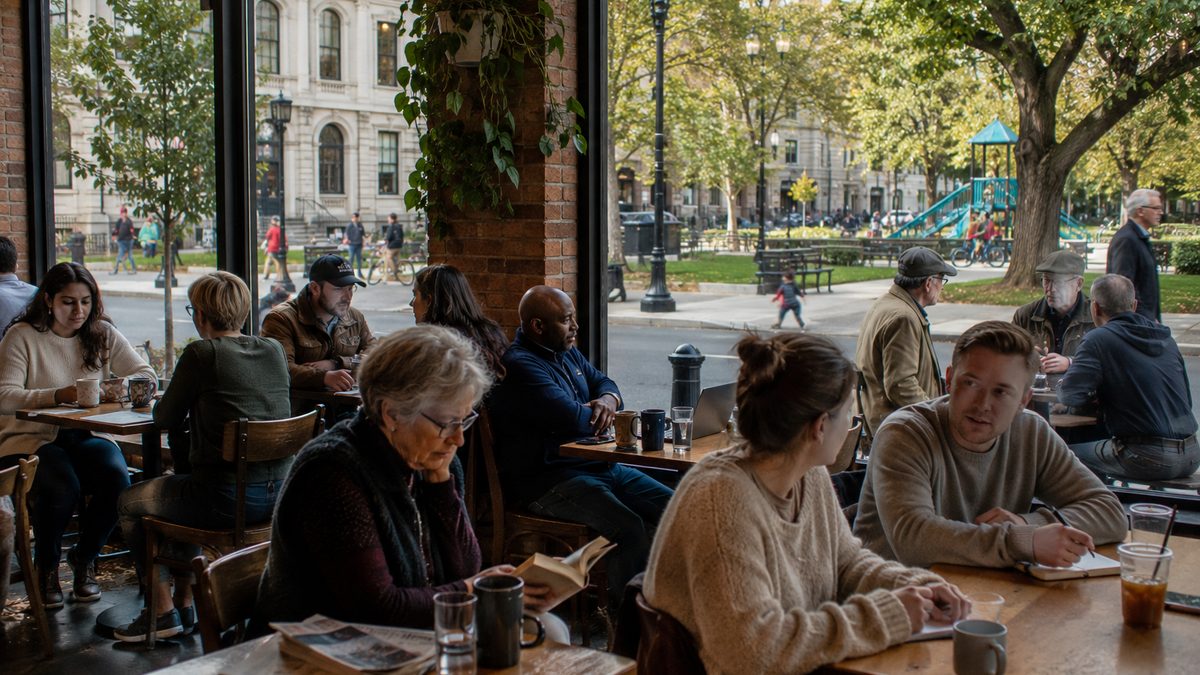
Researchers and community groups are examining how everyday gathering places contribute to social connection and community life. Editorial illustration by TheDailyGlobe.
Key Facts
- Third places are informal gathering spaces outside home and work.
- Examples include libraries, cafes, parks, diners, community centers, and barbershops.
- Recent research efforts are attempting to measure the availability and impact of third places.
- Studies and reports connect social connection with stronger community engagement and belonging.
- Many communities continue searching for ways to preserve or expand accessible public gathering spaces.
Most people know the feeling even if they have never heard the term. It is the coffee shop where staff recognize regular customers. The library where neighbors attend community events. The diner where local news travels faster than social media. The park bench where conversations happen without planning.
Researchers call these places 'third places' because they exist outside the two locations that dominate much of modern life: home and work. Increasingly, researchers and community organizations are trying to understand what happens when those places disappear, become less accessible, or simply become harder to find.
The growing attention reflects a broader question about American society. If people have fewer opportunities for casual face-to-face interaction, what happens to the relationships and trust that communities depend on?
Putting Numbers to Something People Already Feel
For years, discussions about third places were often anecdotal. People would talk about a favorite neighborhood hangout that closed or describe how their community felt different than it once did. What has changed recently is the effort to measure those experiences more systematically.
Projects such as the Third Place Index and research from universities and civic organizations are attempting to identify where gathering spaces exist, how people use them, and what role they play in community life. The goal is not simply to count coffee shops or parks. Researchers are interested in understanding how people connect with one another in everyday settings.
That shift matters because it moves the conversation beyond nostalgia. Rather than debating whether communities feel less connected, researchers are increasingly looking for evidence about where social connection happens and what conditions help support it.
Why Informal Spaces Matter
Many important relationships do not begin in formal settings. They start through repeated encounters: seeing the same people at a library, greeting neighbors at a park, talking with other customers at a diner, or attending a community event.
Those interactions may seem small, but they can create familiarity over time. Familiarity often leads to trust, and trust can influence how people participate in local life. Residents who feel connected to their communities may be more likely to volunteer, attend public meetings, support local organizations, or simply know where to turn when they need help.
Unlike social media platforms, third places allow people to interact with individuals they might not otherwise encounter. Different age groups, occupations, and backgrounds often share the same physical space.
The Challenge of Replacing Them
One reason third places attract attention is that they are difficult to recreate once they disappear. A closed library branch cannot be replaced simply by providing internet access elsewhere. A neighborhood diner offers something different than a food delivery app.
The value often comes from repeated, low-pressure interaction. People do not necessarily visit these places to make friends. They visit for other reasons and friendships sometimes emerge naturally.
Researchers caution that not every community faces the same circumstances. Some towns continue to maintain strong networks of gathering places, while others have experienced changes related to development patterns, economic pressures, transportation challenges, or shifting habits.
What the Research Does and Does Not Show
Current research suggests that social connection matters and that gathering places can help support it. However, available studies do not establish that any single type of venue automatically creates stronger communities.
A coffee shop, library, park, faith community, community center, or barbershop may serve different roles depending on local conditions. What matters most may be whether people have accessible places where they can spend time with others outside structured obligations.
Researchers also note that online communities are not necessarily replacing every function of physical gathering spaces. Digital communication can help people maintain relationships, but it often serves a different purpose than casual in-person interaction.
What Communities May Watch Next
The growing effort to measure third places may influence how local leaders, planners, libraries, nonprofits, and civic organizations think about community development in the coming years.
Future research will likely continue examining which spaces encourage connection and how communities can maintain them. Some places may focus on preserving existing gathering spots, while others may experiment with creating new opportunities for residents to meet and interact.
The larger lesson may be surprisingly simple. Communities are not built only through major institutions or large public projects. They are also shaped by the ordinary places where people see familiar faces, exchange small conversations, and develop the sense that they belong somewhere. Those places can be easy to overlook until they are gone, and increasingly, researchers are trying to understand exactly what they contribute while they are still here.
Reporting note: Reporting draws on research from the Third Place Index, the Chamber of Connection, University of Colorado Boulder researchers, and reviewed background materials. This article was produced with AI-assisted research and reviewed by an editor before publication.